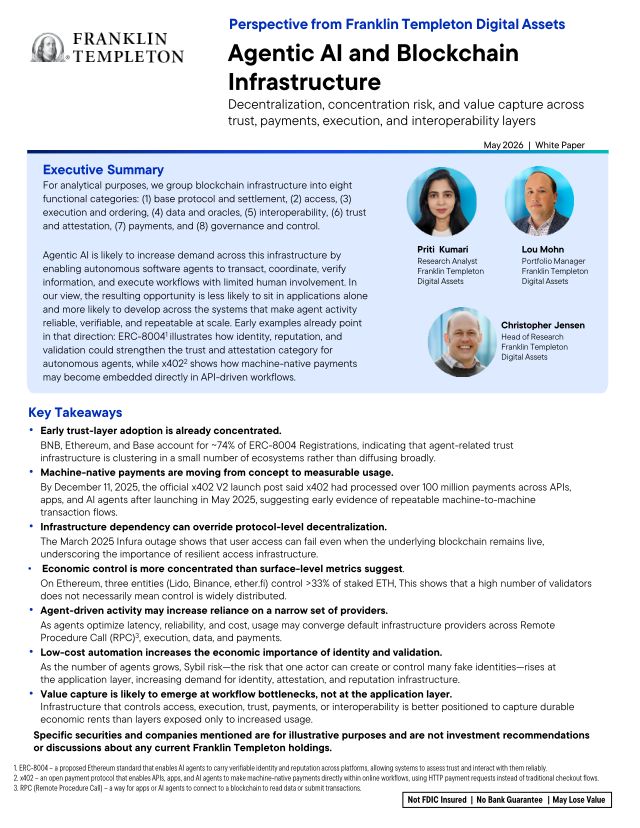
Agentic AI and Blockchain Infrastructure
Quốc gia liên quan:Related countries: Toàn cầuGlobal Hoa KỳUnited States
Tóm tắtSummary
Sách trắng của Franklin Templeton Digital Assets (5/2026) chia hạ tầng blockchain thành tám nhóm chức năng (giao thức nền, truy cập, thực thi, dữ liệu/oracle, liên thông, tin cậy/xác thực, thanh toán, quản trị) và phân tích AI dạng agent sẽ làm tăng nhu cầu ở đâu. Giá trị có thể nằm ở hạ tầng giúp hoạt động của agent đáng tin và lặp lại được, hơn là ở ứng dụng. Ví dụ: chuẩn ERC-8004 cho danh tính và uy tín agent, và giao thức x402 cho thanh toán máy–máy (hơn 100 triệu giao dịch tới 12/2025). Rủi ro: hoạt động của agent có thể dồn vào ít nhà cung cấp, như BNB, Ethereum, Base chiếm 74% đăng ký ERC-8004, và ba thực thể kiểm soát hơn 33% ETH được stake.
Franklin Templeton Digital Assets' white paper (May 2026) groups blockchain infrastructure into eight functions (base protocol, access, execution, data/oracles, interoperability, trust/attestation, payments, governance) and analyses where agentic AI will raise demand. Value is likely to accrue to the infrastructure that makes agent activity reliable and repeatable rather than to applications. Examples: ERC-8004 for agent identity and reputation, and x402 for machine-to-machine payments (over 100m payments by Dec 2025). The risk is concentration: BNB, Ethereum and Base hold 74% of ERC-8004 registrations, and three entities control over 33% of staked ETH.
Điểm chínhKey takeaways
- x402 xử lý hơn 100 triệu thanh toán từ 5/2025 đến 12/2025.
- BNB, Ethereum và Base chiếm khoảng 74% đăng ký ERC-8004.
- Sự cố Infura 3/2025 cho thấy hạ tầng truy cập có thể hỏng dù blockchain vẫn chạy.
- Lido, Binance, ether.fi kiểm soát hơn 33% ETH được stake.
- Agent tăng rủi ro Sybil, làm danh tính và xác thực có giá trị hơn.
- x402 processed over 100m payments between May and Dec 2025.
- BNB, Ethereum and Base account for about 74% of ERC-8004 registrations.
- The March 2025 Infura outage showed access can fail while the chain stays live.
- Lido, Binance and ether.fi control over 33% of staked ETH.
- Agents raise Sybil risk, making identity and attestation more valuable.
Ý kiến chuyên giaExpert opinions
Cơ hội đầu tư nằm ở các “nút thắt quy trình” của agent: thanh toán, danh tính, truy cập.
- Token hạ tầng có thể hưởng lợi khi giao dịch máy–máy tăng.
- Mức tập trung cao tạo rủi ro đơn điểm thất bại.
- Tác giả là nhà quản lý quỹ tài sản số, có lợi ích liên quan.
Investment opportunities sit at agent workflow bottlenecks: payments, identity, access.
- Infrastructure tokens may benefit as machine transactions grow.
- High concentration creates single points of failure.
- The author manages digital-asset funds and is an interested party.
Agent AI tự thanh toán thay mình là tương lai gần, nhưng cần giới hạn chi tiêu.
- Sự cố hạ tầng có thể chặn giao dịch dù tài sản vẫn an toàn.
- Kiểm tra danh tính agent trước khi cấp quyền.
- Không phải khuyến nghị đầu tư token.
AI agents paying on our behalf are near, but need spending limits.
- Infrastructure outages can block transactions even if assets are safe.
- Verify agent identity before granting permissions.
- Not a token investment recommendation.
Khung tám lớp là công cụ phân tích hữu ích cho kinh tế học hạ tầng blockchain.
- Câu hỏi: agent có làm tăng tập trung thị trường vì tối ưu chi phí và độ trễ?
- Số liệu x402 lấy từ thông báo của chính dự án.
- Phi tập trung về kỹ thuật khác phi tập trung về kinh tế.
The eight-layer framework is a useful tool for blockchain infrastructure economics.
- Question: do agents increase market concentration by optimising cost and latency?
- x402 figures come from the project's own announcement.
- Technical decentralisation differs from economic decentralisation.
Thanh toán do agent thực hiện cần quy định về trách nhiệm và xác thực danh tính.
- Ai chịu trách nhiệm khi agent thanh toán sai?
- Rủi ro tập trung ở nhà cung cấp RPC nên được xem như rủi ro bên thứ ba trọng yếu.
- Việt Nam cần chuẩn bị khung cho thanh toán tự động bằng AI.
Agent-made payments need rules on liability and identity verification.
- Who is liable when an agent pays in error?
- RPC concentration should be treated as critical third-party risk.
- Vietnam should prepare a framework for AI-automated payments.
Ý tưởng nghiên cứuResearch ideas
-
Agent và tập trung hạ tầngAgents and infrastructure concentration
Câu hỏiQuestionHoạt động agent có dồn vào ít blockchain và nhà cung cấp hơn không?Does agent activity concentrate on fewer chains and providers?
Dữ liệu & phương phápData & methodDữ liệu ERC-8004 và x402 theo thời gian; chỉ số HHI.ERC-8004 and x402 data over time; HHI.
Đóng góp kỳ vọngExpected contributionKinh tế học mạng lưới.Network economics.
-
Giá trị token hạ tầngInfrastructure token value
Câu hỏiQuestionKhối lượng giao dịch máy–máy có giải thích giá token hạ tầng không?Does machine-to-machine volume explain infrastructure token prices?
Dữ liệu & phương phápData & methodHồi quy chuỗi thời gian.Time-series regressions.
Đóng góp kỳ vọngExpected contributionĐịnh giá tài sản số.Digital-asset valuation.
-
Niềm tin vào agent thanh toánTrust in payment agents
Câu hỏiQuestionNgười dùng chấp nhận để agent chi tiêu thay mình tới mức nào?How much will users let agents spend for them?
Dữ liệu & phương phápData & methodThí nghiệm hành vi.Behavioural experiment.
Đóng góp kỳ vọngExpected contributionThiết kế ủy quyền.Delegation design.
-
Trách nhiệm pháp lý của agentAgent liability
Câu hỏiQuestionKhung trách nhiệm nào phù hợp cho thanh toán do AI khởi tạo?Which liability framework fits AI-initiated payments?
Dữ liệu & phương phápData & methodPhân tích pháp lý so sánh.Comparative legal analysis.
Đóng góp kỳ vọngExpected contributionGợi ý luật.Legal guidance.