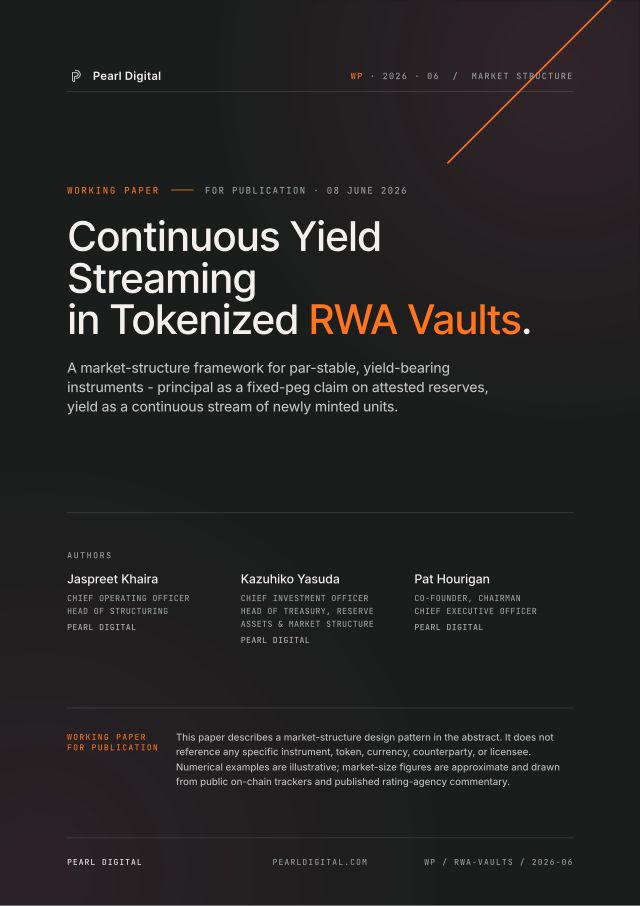
Continuous Yield Streaming in Tokenized RWA Vaults
Quốc gia liên quan:Related countries: Toàn cầuGlobal
Tóm tắtSummary
Bài nghiên cứu cấu trúc thị trường của Pearl Digital (8/6/2026). Hiện có hai loại sản phẩm lợi suất on-chain: RWA token hoá có giá thả nổi theo NAV, và stablecoin sinh lời bằng cách tăng số dư hoặc tăng giá cổ phần. Bài đề xuất loại thứ ba: công cụ giữ giá cố định phát hành từ vault RWA, trong đó gốc là quyền đòi nợ cố định được bảo đảm bằng dự trữ có kiểm chứng, còn lợi suất được “phát trực tiếp” liên tục dưới dạng đơn vị mới đúc. Thiết kế này giữ token dùng được làm tài sản đảm bảo, phương tiện quyết toán và đơn vị kế toán, trong khi vẫn chuyển lợi suất của tài sản thực tới người giữ. Bài mô tả vai trò, dòng tiền, cơ chế quyết toán, điều kiện khả năng thanh toán và phân bổ rủi ro.
A market-structure working paper by Pearl Digital (8 June 2026). On-chain yield products come in two kinds: tokenised RWAs whose price floats with NAV, and yield-bearing stablecoins that rebase or accrue into share price. The paper proposes a third: a par-stable instrument issued from an RWA vault where principal is a fixed claim on attested reserves and yield is streamed continuously as newly minted units. This keeps the token usable as collateral, settlement medium and unit of account while passing through the underlying RWA return. It sets out roles, flows, settlement mechanics, solvency invariants and risk allocation.
Điểm chínhKey takeaways
- Mâu thuẫn hiện nay: đơn vị ổn định khó đồng thời trả lợi suất liên tục.
- Tách gốc (giá cố định) và lợi suất (đơn vị mới đúc liên tục).
- Token vẫn dùng được làm tài sản đảm bảo và phương tiện quyết toán.
- Cần điều kiện khả năng thanh toán và dự trữ được kiểm chứng.
- Bài mô tả thiết kế trừu tượng, không gắn sản phẩm cụ thể.
- Today's tension: a stable unit struggles to also pay continuous yield.
- Separate principal (fixed peg) from yield (continuously minted units).
- The token stays usable as collateral and settlement medium.
- Requires solvency invariants and attested reserves.
- The design is described in the abstract, not tied to a product.
Ý kiến chuyên giaExpert opinions
Cấu trúc này có thể mở rộng thị trường cho trái phiếu token hoá làm tài sản đảm bảo DeFi.
- Giá cố định giúp kế toán và quản trị rủi ro đơn giản hơn cho tổ chức.
- Cạnh tranh trực tiếp với stablecoin sinh lời và quỹ tiền tệ token hoá.
- Phụ thuộc vào chất lượng kiểm chứng dự trữ.
This structure could widen markets for tokenised bonds as DeFi collateral.
- A fixed price simplifies accounting and risk management for institutions.
- Competes directly with yield stablecoins and tokenised MMFs.
- Depends on reserve-attestation quality.
Nhận lợi suất liên tục mà giá token không đổi nghe hấp dẫn, nhưng vẫn có rủi ro tài sản gốc.
- Dự trữ là tài sản thực có thể mất giá.
- Kiểm tra ai kiểm chứng dự trữ và tần suất.
- Đây là bài của công ty thiết kế sản phẩm.
Continuous yield on a stable token sounds attractive, but underlying-asset risk remains.
- Reserves are real assets that can lose value.
- Check who attests reserves and how often.
- The paper is by a product designer.
Đóng góp lý thuyết về thiết kế công cụ tiền tệ có lợi suất.
- Câu hỏi: đúc đơn vị liên tục có gây lạm phát nội bộ token?
- Có thể so sánh với quỹ tiền tệ giá cố định (CNAV) trong tài chính truyền thống.
- Thiếu dữ liệu thực nghiệm.
A theoretical contribution on yield-bearing monetary instruments.
- Question: does continuous minting cause internal token inflation?
- Comparable to constant-NAV money market funds.
- No empirical data.
Công cụ giữ giá cố định trả lợi suất có thể bị coi là chứng khoán hoặc tiền gửi.
- GENIUS và MiCA cấm stablecoin trả lãi; cấu trúc này cần phân loại pháp lý rõ.
- Yêu cầu kiểm toán dự trữ thường xuyên.
- Bài học từ quỹ CNAV năm 2008: giá cố định có thể gãy khi căng thẳng.
A par-stable yield instrument may be treated as a security or a deposit.
- GENIUS and MiCA ban interest on stablecoins; this structure needs clear classification.
- Require frequent reserve audits.
- Lesson from 2008 CNAV funds: fixed prices can break under stress.
Ý tưởng nghiên cứuResearch ideas
-
Ổn định giá của công cụ lợi suất liên tụcStability of streaming-yield instruments
Câu hỏiQuestionCấu trúc tách gốc–lợi suất có giữ giá tốt hơn stablecoin sinh lời không?Does a principal–yield split hold the peg better than yield stablecoins?
Dữ liệu & phương phápData & methodSo sánh độ lệch giá on-chain.Compare on-chain peg deviations.
Đóng góp kỳ vọngExpected contributionThiết kế tiền ổn định.Stable-money design.
-
Cầu tài sản đảm bảo có lợi suấtDemand for yield-bearing collateral
Câu hỏiQuestionTổ chức có ưu tiên tài sản đảm bảo giá cố định có lợi suất?Do institutions prefer par-stable yield collateral?
Dữ liệu & phương phápData & methodDữ liệu giao thức cho vay DeFi.DeFi lending protocol data.
Đóng góp kỳ vọngExpected contributionThị trường tài sản đảm bảo on-chain.On-chain collateral markets.
-
Nhà đầu tư nhỏ hiểu rủi ro?Do retail investors understand the risk?
Câu hỏiQuestionGiá cố định có làm người dùng đánh giá thấp rủi ro?Does a fixed price make users underestimate risk?
Dữ liệu & phương phápData & methodThí nghiệm hành vi.Behavioural experiment.
Đóng góp kỳ vọngExpected contributionBảo vệ nhà đầu tư.Investor protection.
-
Phân loại pháp lýLegal classification
Câu hỏiQuestionCông cụ này nên xếp vào chứng khoán, tiền điện tử hay quỹ?Should this instrument be a security, e-money or a fund?
Dữ liệu & phương phápData & methodPhân tích pháp lý so sánh.Comparative legal analysis.
Đóng góp kỳ vọngExpected contributionKhung quy định.Regulatory framework.