RWATimes

Kho báo cáo về tài sản thực token hoá (RWA) và trí tuệ nhân tạo (AI), cập nhật liên tụcA continuously updated library of research on tokenized real-world assets (RWA) and artificial intelligence (AI)

60 báo cáo60 reports

RWA Phát hành ~Q2/2026Released ~Q2 2026 · World Bank Group · ĐăngPosted

Digital Wallets: A New Paradigm — Convergence of User-Centric Digital Identity, Data Sharing and Payments

Ghi chú chính sách số 1 của Ngân hàng Thế giới (2026, Christopher Tullis, Adam Cooper, David Black) về ví số như nơi hội tụ của danh tính số, chia sẻ dữ liệu và thanh toán, lấy người dùng làm trung tâm. Ví thế hệ mới cho phép người dân giữ giấy tờ số, chia sẻ dữ liệu có kiểm soát và thanh toán trong cùng một ứng dụng. Các ví dụ: Diia của Ukraine (“nhà nước trong điện thoại”), SingPass của Singapore, gov.br của Brazil, DigiLocker của Ấn Độ (hơn 434 triệu người dùng năm 2024), M-Pesa, Pix và khung ví danh tính số EUDI của EU. Ghi chú giải thích cách ví hoạt động, kiến trúc, thành phần và các lựa chọn chính sách cho chính phủ.World Bank Digital Wallet Policy Note No. 1 (2026, Christopher Tullis, Adam Cooper, David Black) on digital wallets as a user-centric convergence of digital identity, data sharing and payments. Next-generation wallets let people hold digital documents, share data with consent and pay in one app. Examples: Ukraine's Diia (state in a smartphone), Singapore's SingPass, Brazil's gov.br, India's DigiLocker (over 434m users in 2024), M-Pesa, Pix and the EU Digital Identity (EUDI) wallet framework. The note explains how wallets work, their architecture and components, and policy choices for governments.
Digital WalletsDigital IdentityData SharingPaymentsPublic Policy
RWA Phát hành ~Q3/2026Released ~Q3 2026 · The ValueExchange & ISSA · ĐăngPosted

DLT in the Real World 2026: Where, how and why DLT is transforming the capital markets

Khảo sát thường niên lần thứ 7 của The ValueExchange và ISSA với 510 tổ chức trên thị trường vốn (quý 2/2026) cho thấy DLT đã chuyển từ giai đoạn thử nghiệm sang triển khai thực tế. Mức độ quan trọng chiến lược của DLT đạt 7,8/10, cao nhất từ trước tới nay, và ngân sách cho DLT tăng khoảng 20%/năm, gấp hơn ba lần tốc độ tăng chi phí vận hành chứng khoán nói chung. Quỹ thị trường tiền tệ token hoá và stablecoin là hai loại tài sản dẫn đầu năm nay; token hoá tài sản đảm bảo được dự báo trở thành ứng dụng số 1 vào năm 2027. Trở ngại lớn nhất không còn là công nghệ mà là việc khách hàng và đối tác chưa tham gia (92%), khiến ai cũng chọn làm “người theo sau nhanh”.The seventh annual ValueExchange–ISSA survey of 510 capital-markets institutions (Q2 2026) finds DLT moving from experimentation into real deployment. Strategic importance hits a record 7.8/10 and DLT budgets are growing about 20% a year, more than three times the pace of overall securities-operations spend. Tokenised money market funds and stablecoins are this year's leading asset classes, and collateral tokenisation is on track to become the #1 use case in 2027. The main blocker is no longer technology but client and counterparty adoption (92%), which keeps firms in a “fast follower” stand-off.

TokenizationCollateralMoney Market FundsStablecoinsTokenized DepositsSurvey
RWA Phát hành ~2026Released ~2026 · Ubyx & stakeFi (Tony McLaughlin, Brett Hornung) · ĐăngPosted

Banks Should Validate Public Blockchains: The case for regulated institutions at the base layer

Whitepaper của Tony McLaughlin (CEO Ubyx, người khởi xướng ý tưởng Regulated Liability Network khi ở Citi) và Brett Hornung (stakeFi) lập luận rằng việc yêu cầu ngân hàng tránh xa blockchain công khai không làm giảm rủi ro, mà chỉ khiến mảng tài chính tăng trưởng nhanh nhất phát triển thiếu nhà cung cấp được quản lý. Ngân hàng nên chạy validator (nút xác thực) trên blockchain công khai: vừa giúp bảo mật mạng lưới, vừa nhận phần thưởng, vừa có tiếng nói ở tầng nền của hạ tầng tiền token hoá. Ngân hàng tham gia như một thành viên ngang hàng, không sở hữu hay kiểm soát mạng. Lộ trình đề xuất: chọn mạng, chạy validator, quản lý rủi ro bằng kỷ luật sẵn có, rồi phát hành tiền gửi token hoá trên chính hạ tầng mình giúp bảo mật.Tony McLaughlin (Ubyx CEO, who originated the Regulated Liability Network idea at Citi) and Brett Hornung (stakeFi) argue that telling banks to keep off public blockchains did not reduce risk; it left the fastest-growing part of finance without regulated providers. Banks should run validators: securing networks, earning rewards and gaining a seat at the base layer of tokenized-money infrastructure. Banks join as peers, without owning or controlling networks. The ask: choose networks, run validators, manage risk with existing disciplines, then issue tokenized deposits on the rails they help secure.

BanksValidatorsStakingPublic BlockchainsTokenized Deposits
RWA Phát hành ~Q3/2026Released ~Q3 2026 · Thunes · ĐăngPosted

Cross-Border Payments in Africa: Regional Spotlight, Interoperability Index Report

Báo cáo của Thunes dùng Chỉ số Khả năng tương tác xuyên biên giới để xếp hạng châu Phi: Kenya dẫn đầu khu vực (hạng 36 toàn cầu), tiếp theo Nigeria, Nam Phi, Ai Cập. Châu Phi vẫn đắt đỏ khi kết nối qua ngân hàng truyền thống vì chuỗi ngân hàng đại lý dài. Thanh toán nội khối đang cải thiện nhờ PAPSS (21 ngân hàng trung ương tham gia) và liên minh tiền di động, nhưng tiền di động vẫn là hệ thống khép kín, khó chuyển ra nước ngoài. Nigeria nổi bật về stablecoin: 29% người được khảo sát đã dùng, và 40% người gửi tiền quốc tế dùng nền tảng crypto (so với 11% toàn cầu).Thunes' Cross-border Interoperability Index ranks Africa: Kenya leads the region (36th globally), followed by Nigeria, South Africa and Egypt. Africa remains costly to connect via legacy banking because of long correspondent chains. Intra-African payments are improving through PAPSS (21 central banks) and mobile-money alliances, but mobile money remains closed-loop and hard to send abroad. Nigeria stands out on stablecoins: 29% of respondents already use them, and 40% of international senders use crypto platforms (versus 11% globally).

Cross-border PaymentsAfricaMobile MoneyStablecoinsInteroperability
AI Phát hành 06/2026Released 06/2026 · The Big Whale Research · ĐăngPosted

Benchmark: AI Agents x Stablecoins — The payment infrastructure for the autonomous economy

Báo cáo của The Big Whale (6/2026) cho rằng thanh toán là bức tường cản việc triển khai AI agent: 93% lãnh đạo muốn dùng agent nhưng chỉ 2% đã triển khai quy mô lớn. Agent cần trả tiền trong hai giây, với số tiền rất nhỏ, không cần người can thiệp, điều mà SEPA, thẻ hay SWIFT không đáp ứng. Theo tác giả, stablecoin là công cụ duy nhất đáp ứng đồng thời bốn yêu cầu: lập trình được, quyết toán tức thì, ổn định giá, phí gần bằng không. Thị trường thanh toán bằng agent dự báo tăng từ 7 tỷ lên 93 tỷ USD vào 2032; đến 4/2026 đã có 69.000 agent hoạt động trên x402 với hơn 165 triệu giao dịch. Stripe và Circle là hai trụ cột; ngân hàng mới ở mức thí điểm; châu Âu có “điểm mù” vì thiếu stablecoin euro phổ biến.The Big Whale's report (June 2026) argues payments are the wall blocking AI-agent deployment: 93% of executives want agents but only 2% have deployed at scale. Agents need to pay in two seconds, for fractions of a cent, without human input, which SEPA, cards and SWIFT cannot do. The author argues stablecoins alone meet all four needs: programmability, instant settlement, price stability and near-zero fees. Agentic payments are projected to grow from USD 7bn to USD 93bn by 2032; by April 2026, 69,000 agents were active on x402 with over 165m transactions. Stripe and Circle are the pillars; banks are still piloting; Europe has a blind spot without a widely used euro stablecoin.

AI AgentsStablecoinsAgentic PaymentsStripeEurope
RWA Phát hành ~Q3/2026Released ~Q3 2026 · Tempo · ĐăngPosted

Tokenized Deposits for Banks: A Primer

Tài liệu nhập môn của Tempo giải thích tiền gửi token hoá: tiền gửi ngân hàng bình thường được ghi và chuyển trên blockchain. Bản chất khoản nợ không đổi: vẫn là nghĩa vụ của ngân hàng, đủ điều kiện bảo hiểm tiền gửi và có thể trả lãi; chỉ sổ cái thay đổi. Các ngân hàng lớn (J.P. Morgan, Citi, HSBC, BNY) đã chạy sản phẩm thật từ 2020, nhưng giới hạn chung là chỉ chuyển được trong nội bộ ngân hàng phát hành. Ba ràng buộc đã nới lỏng trong giai đoạn 2024–2026: pháp lý (EBA, GENIUS Act, chuẩn crypto của Basel, đề xuất của FDIC), lớp liên ngân hàng (The Clearing House, sổ cái Swift, Project Agorá) và áp lực cạnh tranh từ stablecoin. Hai quyết định thực tế với mỗi ngân hàng: sổ nào là bản ghi chính thức (hệ thống lõi hay blockchain), và thanh toán liên ngân hàng bằng cách nào.Tempo's primer explains tokenized deposits: ordinary bank deposits recorded and moved on blockchain. The claim is unchanged: still a bank liability, deposit-insurance eligible and able to earn interest; only the ledger differs. Large banks (J.P. Morgan, Citi, HSBC, BNY) have run live versions since 2020, but all share one limit: money moves only within the issuing bank. Three constraints eased in 2024–2026: legal (EBA, GENIUS Act, Basel crypto standard, FDIC proposal), the interbank layer (The Clearing House, Swift's ledger, Project Agorá) and competitive pressure from stablecoins. Each bank faces two decisions: which record is authoritative (core systems or blockchain), and how to settle with other banks.

Tokenized DepositsBanksInterbank SettlementDeposit InsuranceInteroperability
RWA Phát hành ~2026Released ~2026 · Tempo · ĐăngPosted

The Enterprise Guide to Stablecoin Earn Programs

Hướng dẫn của Tempo dành cho doanh nghiệp (ví, neobank, nền tảng chi trả) muốn tích hợp chương trình “Earn” cho phép khách hàng nhận lợi suất trên số dư stablecoin. Stablecoin ngày càng dùng cho trả lương, chi trả cho người bán và thanh toán B2B xuyên biên giới (DoorDash hợp tác với Tempo, Deel ra ví stablecoin); McKinsey ước tính thanh toán thực bằng stablecoin đạt 390 tỷ USD năm 2025, gấp đôi năm trước. Chương trình Earn tạo giá trị qua tăng doanh thu, thu hút người dùng và tăng gắn kết. Ba nguồn lợi suất: tương đương tiền (MMF token hoá như BUIDL, USDY, khoảng 3,5%/năm), tín dụng tổ chức và quỹ thay thế (ACRED, PRIME, 5–8%), và giao thức cho vay DeFi (Morpho, Aave, 3–5%). Triển khai mất 1–2 tháng (giải pháp có sẵn) đến 3–6 tháng (tuỳ biến).Tempo's guide for enterprises (wallets, neobanks, payout platforms) adding “Earn” programs that pay yield on stablecoin balances. Stablecoins are increasingly used for payroll, merchant payouts and cross-border B2B (DoorDash working with Tempo, Deel launching a stablecoin wallet); McKinsey estimates USD 390bn of real stablecoin payments in 2025, double the prior year. Earn creates value by driving revenue, attracting users and deepening engagement. Three yield sources: cash equivalents (tokenized MMFs such as BUIDL, USDY, ~3.5% APY), institutional credit and alternative funds (ACRED, PRIME, 5–8%), and DeFi lending (Morpho, Aave, 3–5%). Launch takes 1–2 months (plug-and-play) to 3–6 months (custom).

StablecoinsYieldTokenized MMFsDeFi LendingNeobanks
AI Phát hành ~Q2/2026Released ~Q2 2026 · Tech Mahindra (Gopal Parasnis, Saurabh Agrawal) · ĐăngPosted

Redefining Intelligent Banking with Agentic AI: A Practical Guide to Autonomous, Trusted, and Scalable Banking Transformation

Whitepaper của Tech Mahindra về triển khai AI dạng agent (tự lập kế hoạch và thực hiện quy trình) trong ngân hàng. Chi tiêu toàn cầu cho agentic AI dự kiến đạt 52,62 tỷ USD năm 2030, mảng dịch vụ tài chính tăng 41%/năm, nhưng chỉ 11% doanh nghiệp đã đưa agent vào vận hành thực tế. Khảo sát 150 lãnh đạo ngân hàng cho thấy 38% đầu tư mạnh, 37% đầu tư vừa đủ và 25% đầu tư chưa đủ. Tài liệu đề xuất kiến trúc agent cho front, middle và back office, bắt đầu từ back office rủi ro thấp; mô hình con người trong vòng lặp; năm điều kiện tiên quyết (dữ liệu, quản trị, đo lường tác động, công nghệ, nhân lực); và lộ trình bốn giai đoạn. Phần lớn nội dung giới thiệu nền tảng Orion (hợp tác với NVIDIA) và VerifAI của công ty.Tech Mahindra's whitepaper on deploying agentic AI (systems that plan and execute workflows) in banking. Global agentic AI spending is forecast at USD 52.62bn by 2030, with financial services growing 41% a year, yet only 11% of companies have agents in production. A survey of 150 bank executives finds 38% investing aggressively, 37% just enough and 25% underinvesting. It proposes an agent architecture across front, middle and back office, starting with low-risk back office; a human-in-the-loop model; five prerequisites (data, governance, impact measurement, technology, talent); and a four-phase roadmap. Much of the paper promotes the firm's Orion platform (built with NVIDIA) and VerifAI.

Agentic AIBankingHuman-in-the-LoopResponsible AIOperations
AI Phát hành ~Q1/2026Released ~Q1 2026 · Stripe · ĐăngPosted

Pricing AI products: Lessons from leading AI companies

Hướng dẫn của Stripe (bản tiếng Anh-Anh) về cách định giá sản phẩm AI, dựa trên trao đổi với chuyên gia định giá của Anthropic, Clay, Fin, PostHog, Vercel và Bessemer Venture Partners. Trên Stripe, top 100 công ty AI đạt 1 triệu USD doanh thu năm hoá trong 11,5 tháng, nhanh hơn 3,5 tháng so với top 100 công ty SaaS. Nhưng kiếm tiền từ AI khó hơn vì chi phí suy luận biến động, khiến gói thuê bao cố định dễ thu quá cao hoặc quá thấp. Khảo sát của Stripe: 56% lãnh đạo công ty AI dùng định giá lai, 38% định giá thuần theo mức sử dụng. Khung 5 bước: xác định chỉ số giá trị, chọn chỉ số tính phí, chọn mô hình giá, đặt rào chắn (giới hạn chi tiêu, cảnh báo), và liên tục điều chỉnh.Stripe's guide (UK English edition) to pricing AI products, built from conversations with pricing leads at Anthropic, Clay, Fin, PostHog, Vercel and Bessemer Venture Partners. On Stripe, the top 100 AI companies reach USD 1m in annualised revenue in 11.5 months, 3.5 months faster than the top 100 SaaS firms. But monetising AI is harder because inference costs vary, so flat subscriptions risk over- or under-charging. Stripe's survey: 56% of AI company leaders use hybrid pricing and 38% purely usage-based pricing. A five-step framework: set a value metric, set a charge metric, pick a pricing model, set guardrails (spend caps, alerts) and keep iterating.

AI Business ModelsPricingUsage-Based BillingAI StartupsMonetisation
AI Phát hành 06/2026Released 06/2026 · Stanford Digital Economy Lab · ĐăngPosted

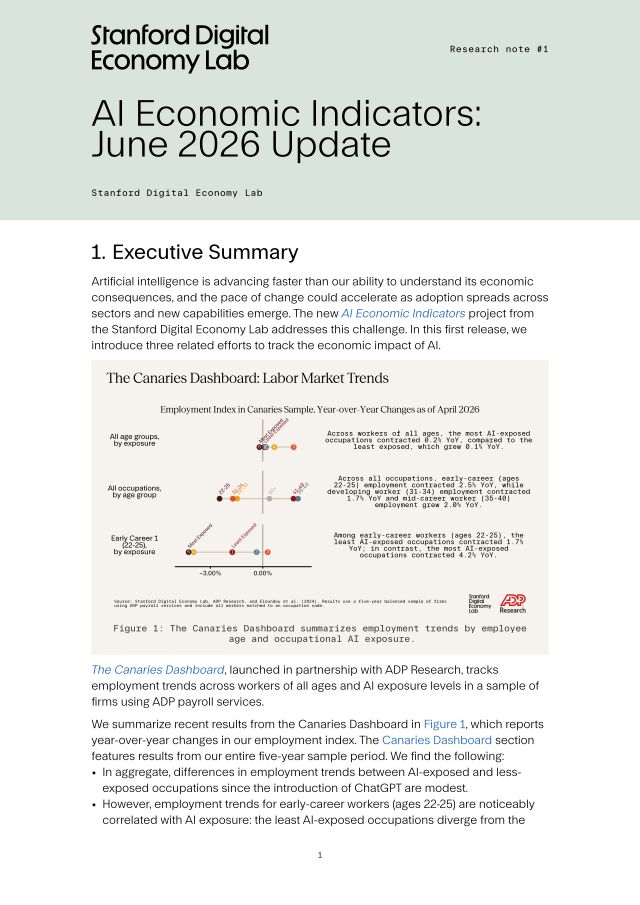
AI Economic Indicators: June 2026 Update

Ghi chú nghiên cứu đầu tiên của dự án Chỉ số kinh tế AI (Stanford Digital Economy Lab, 6/2026) với ba công cụ. Canaries Dashboard (cùng ADP) theo dõi việc làm theo tuổi và mức độ tiếp xúc AI: chênh lệch chung giữa nghề tiếp xúc nhiều và ít với AI còn nhỏ, nhưng lao động trẻ 22–25 tuổi ở nghề tiếp xúc nhiều có xu hướng việc làm kém hơn rõ; AI dùng để tự động hoá (thay vì hỗ trợ) gắn với việc làm giảm. Takeoff Tracker theo dõi 12 chỉ số “cất cánh”: đến 5/2026, 7 chỉ số chưa có dấu hiệu, 3 có dấu hiệu nhẹ, 2 có dấu hiệu mạnh. Adoption Monitor cho thấy mức dùng AI tăng nhưng có dấu hiệu chững lại ở nơi làm việc.The first research note of the Stanford Digital Economy Lab's AI Economic Indicators project (June 2026) with three tools. The Canaries Dashboard (with ADP) tracks employment by age and AI exposure: the overall gap between more- and less-exposed occupations is modest, but early-career workers (22–25) in exposed jobs fare noticeably worse, and automation-type AI use (not augmentation) correlates with weaker employment. The Takeoff Tracker follows 12 takeoff indicators: as of May 2026, seven show no takeoff, three mild and two strong evidence. The Adoption Monitor finds rising AI use but signs of a workplace reversal.

AI and JobsLabour MarketAI AdoptionProductivityEconomic Data
RWA Phát hành 10/2026Released 10/2026 · S&P Global Ratings · ĐăngPosted

Analytical Approach: Vault Risk Assessments

S&P Global Ratings công bố (04/10/2026) phương pháp Đánh giá Rủi ro Vault (VRA) cho các vault cho vay: hợp đồng thông minh gom và phân bổ tài sản số vào thị trường cho vay on-chain, có tài sản đảm bảo là crypto hoặc tài sản thực token hoá, trong môi trường cấp phép hoặc không cấp phép. VRA là ý kiến mang tính tương đối và hướng tới tương lai về rủi ro suy giảm vị thế của nhà đầu tư, ký hiệu có hậu tố “v” (ví dụ AAA(v) là rủi ro thấp nhất). VRA không phải xếp hạng tín dụng và không bình luận về lợi suất. Quy trình bốn bước: đánh giá chất lượng tín dụng danh mục; đánh giá curator và độ lệch thanh khoản; đánh giá blockchain, giao thức, quản trị và an ninh; và quy đổi sang thang chữ, có điều chỉnh tổng thể.S&P Global Ratings published (4 Oct 2026) its Vault Risk Assessment (VRA) approach for lending vaults: smart contracts that pool and allocate digital assets to on-chain lending markets collateralised by crypto or tokenized RWAs, in permissioned or permissionless settings. A VRA is a forward-looking, relative opinion on the risk of impairment to an investor's position, marked with a “v” suffix (e.g. AAA(v) is lowest risk). It is not a credit rating and does not comment on yield. Four steps: portfolio credit-quality assessment; curator and liquidity-mismatch assessments; blockchain, protocol, governance and security assessments; and mapping to a letter scale with holistic adjustment.

DeFiVaultsCredit RiskRatingsLending
RWA Phát hành ~Q2/2026Released ~Q2 2026 · Singapore Management University (Nydia Remolina) · ĐăngPosted

Against Crypto Exceptionalism in Financial Regulation

Bài nghiên cứu luật của TS Nydia Remolina (Đại học Quản lý Singapore) so sánh cách quản lý tài sản crypto ở EU, Singapore, Nhật Bản, Hồng Kông và Anh, đối chiếu với Thuỵ Sĩ và Canada. Các nước hoặc tạo một loại pháp lý riêng cho crypto (EU, Anh), hoặc nhét hoạt động crypto vào khung có sẵn như dịch vụ thanh toán (Singapore, Nhật trước đây). Nhưng nghĩa vụ thực chất (công bố thông tin, lưu ký, tách tài sản khách hàng, quản trị, an toàn vốn, chống thao túng) đều mượn từ luật chứng khoán và tài chính truyền thống. Tác giả cho rằng “ngoại lệ crypto” gây trùng lặp, làm yếu tính trung lập công nghệ và mờ ranh giới giữa luật thanh toán, chứng khoán và an toàn vốn, và đề xuất quản lý theo chức năng kinh tế thay vì theo nhãn crypto.A legal paper by Dr Nydia Remolina (Singapore Management University) comparing crypto regulation in the EU, Singapore, Japan, Hong Kong and the UK, contrasted with Switzerland and Canada. Jurisdictions either create a sui generis crypto category (EU, UK) or fit crypto into existing regimes such as payment services (Singapore, historically Japan). Yet the substantive duties (disclosure, custody, client-asset segregation, governance, prudential safeguards, market integrity) are all transplanted from traditional securities and financial law. The author argues crypto exceptionalism causes duplication, weakens technology neutrality and blurs the line between payments, securities and prudential law, and proposes regulating by economic function rather than the crypto label.

Crypto RegulationComparative LawFunctional RegulationMiCASingapore
RWA Phát hành ~Q2/2026Released ~Q2 2026 · Ripple · ĐăngPosted

The Functional Evolution of Digital Assets: From Speculation to Infrastructure — Tokenized Finance

Báo cáo của Ripple lập luận “kỷ nguyên đầu cơ đã kết thúc”: stablecoin đã chứng minh tiện ích của blockchain (giữ giá trị, chuyển xuyên biên giới gần như miễn phí, thanh toán trong vài giây), và tiền gửi token hoá là bước tiếp theo. Tổ chức tài chính không còn hỏi có tham gia hay không mà hỏi làm thế nào ở quy mô lớn với quản trị phù hợp. Báo cáo trả lời ba câu hỏi: vì sao tiền token hoá chuyển vào trung tâm tài chính tổ chức; ý nghĩa với ngân hàng, ngân quỹ và thị trường vốn; và vì sao hạ tầng lưu ký là nền tảng để mở rộng. GENIUS Act tạo khung cấp phép liên bang cho stablecoin; CLARITY Act (nếu thông qua) sẽ yêu cầu lưu ký đủ điều kiện.Ripple argues the era of speculation is over: stablecoins proved blockchain utility (holding value, near-free cross-border transfers, settlement in seconds), and tokenized deposits come next. Institutions no longer ask whether to participate but how to scale with proper governance. The report addresses why tokenized money is moving to the core of institutional finance, what it means for banks, treasuries and capital markets, and why custody infrastructure is the foundation for scale. The GENIUS Act creates federal stablecoin licensing; the CLARITY Act, if enacted, would require qualified custody.

StablecoinsTokenized DepositsCustodyGENIUS ActTokenization
RWA Phát hành 06/2026Released 06/2026 · Pearl Digital (working paper) · ĐăngPosted

Continuous Yield Streaming in Tokenized RWA Vaults

Bài nghiên cứu cấu trúc thị trường của Pearl Digital (8/6/2026). Hiện có hai loại sản phẩm lợi suất on-chain: RWA token hoá có giá thả nổi theo NAV, và stablecoin sinh lời bằng cách tăng số dư hoặc tăng giá cổ phần. Bài đề xuất loại thứ ba: công cụ giữ giá cố định phát hành từ vault RWA, trong đó gốc là quyền đòi nợ cố định được bảo đảm bằng dự trữ có kiểm chứng, còn lợi suất được “phát trực tiếp” liên tục dưới dạng đơn vị mới đúc. Thiết kế này giữ token dùng được làm tài sản đảm bảo, phương tiện quyết toán và đơn vị kế toán, trong khi vẫn chuyển lợi suất của tài sản thực tới người giữ. Bài mô tả vai trò, dòng tiền, cơ chế quyết toán, điều kiện khả năng thanh toán và phân bổ rủi ro.A market-structure working paper by Pearl Digital (8 June 2026). On-chain yield products come in two kinds: tokenised RWAs whose price floats with NAV, and yield-bearing stablecoins that rebase or accrue into share price. The paper proposes a third: a par-stable instrument issued from an RWA vault where principal is a fixed claim on attested reserves and yield is streamed continuously as newly minted units. This keeps the token usable as collateral, settlement medium and unit of account while passing through the underlying RWA return. It sets out roles, flows, settlement mechanics, solvency invariants and risk allocation.

RWA VaultsYield-Bearing StablecoinsMarket StructureTokenized FundsCollateral
RWA Phát hành 09/2026Released 09/2026 · Pantera Capital Research · ĐăngPosted

The State of Tokenization: Tracking demand and liquidity in the tokenization market

Báo cáo của Pantera Capital (09/2026, số liệu đến 30/06/2026 kèm cập nhật quý 3) cho rằng phát hành token đã dễ, thách thức tiếp theo là xây thị trường thứ cấp tuân thủ, thanh khoản và hiệu quả vốn. Giao dịch và mức độ tham gia phân hoá mạnh. Trong 110 sản phẩm không phải stablecoin (mỗi sản phẩm từ 10 triệu USD), sản phẩm mở truy cập nắm 41% giá trị nhưng tạo ra 99,8% khối lượng giao dịch giao ngay tháng 6; 46/48 sản phẩm chỉ cho ví trong danh sách trắng có vòng quay dưới ngưỡng. Hợp đồng vĩnh cửu (perpetual) cổ phiếu trên Hyperliquid và Lighter đạt 67,8 tỷ USD trong tháng 6, gấp khoảng 16 lần giao dịch giao ngay cổ phiếu token hoá. Robinhood Chain (ra mắt 01/07) cho thấy kênh phân phối tiêu dùng hiệu quả. Báo cáo khuyến nghị đánh giá từng sản phẩm theo đúng mục đích sử dụng, không dùng một thước đo chung.Pantera Capital's report (Sep 2026; data to 30 Jun 2026 plus Q3 updates) says issuing tokens is easy; the next frontier is compliant, liquid, capital-efficient secondary markets. Trading and participation are sharply bifurcated. Among 110 non-stablecoin products of USD 10mn+, open-access products held 41% of value but generated 99.8% of June spot trading; 46 of 48 whitelist-only products fell below the turnover threshold. Equity perpetuals on Hyperliquid and Lighter traded USD 67.8bn in June, ~16x tokenized-equity spot volume. Robinhood Chain (launched 1 Jul) showed effective consumer distribution. Products should be judged by metrics matching their intended use.

TokenizationTokenized EquitiesLiquidityPerpetualsMarket Structure
RWA Phát hành 10/2026Released 10/2026 · OMFIF Digital Monetary Institute · ĐăngPosted

DMI Journal: The Autonomy Economy — AI in payments (October 2026)

Số tạp chí tháng 10/2026 của Viện Tiền tệ Số OMFIF bàn về “nền kinh tế tự hành”, khi tác tử AI không chỉ gợi ý mà tự hoàn tất giao dịch. Bản PDF 8 trang gồm lời mở đầu và mục tin tức, tổng hợp quan điểm của các tác giả từ Circle, Coinbase, IMF, Barclays, Oracle, Hedera, Agio Ratings và Global Women in AI. Các ý chính: stablecoin có thể là kênh quan trọng cho thanh toán tác tử vì chi phí biên rất thấp; tốc độ của tác tử là thách thức lớn cho giám sát; tác tử dùng cùng mô hình có thể gây sập giá chớp nhoáng (flash crash) và rút vốn đồng loạt; AI có thể kế thừa bất bình đẳng trong dữ liệu. Mục tin tức ghi nhận Santander và Mastercard thực hiện thanh toán đầu-cuối đầu tiên ở châu Âu do tác tử AI thực hiện, và HKEX–HKMA thí điểm e-HKD bán buôn cho ký quỹ ngoài giờ.OMFIF's Digital Monetary Institute October 2026 journal covers the “autonomy economy”, where AI agents not only advise but complete transactions. The 8-page PDF holds the foreword and news review, summarising contributors from Circle, Coinbase, the IMF, Barclays, Oracle, Hedera, Agio Ratings and Global Women in AI. Key points: stablecoins may be a key vector for agentic payments given near-zero marginal cost; agents' speed challenges supervisors; agents running the same models could trigger flash crashes and runs; AI may inherit inequalities in data. News includes Santander and Mastercard completing Europe's first live end-to-end AI-agent payment and an HKEX–HKMA pilot using wholesale e-HKD for after-hours margin.

Agentic AIPaymentsStablecoinsCentral BanksRegulation
RWA Phát hành 06/2026Released 06/2026 · Malta Financial Services Authority (MFSA) · ĐăngPosted

Decentralised Finance (DeFi) Discussion Paper: Strengthening Malta's Position as a Jurisdiction for Next Generation Financial Services

Tài liệu thảo luận của Cơ quan Dịch vụ Tài chính Malta (MFSA, 12/6/2026, nhận góp ý đến 10/7/2026) về cách đưa Malta thành nơi phát triển tài chính phi tập trung (DeFi) có quản lý. Nội dung gồm: tác động của MiCA với DeFi và việc tổ chức được cấp phép dùng sản phẩm DeFi; rủi ro tội phạm tài chính và chuẩn quốc tế; mô hình tổ chức dựa trên phần mềm; dùng công ty tế bào tách biệt (SCC) để cô lập rủi ro hợp đồng thông minh; và “guardian agents” (tác nhân giám hộ) như công cụ quản lý rủi ro và bảo vệ thị trường gắn sẵn trong giao thức. MFSA đặt 30 câu hỏi để lấy ý kiến trước khi đưa ra đề xuất chi tiết.A discussion paper by the Malta Financial Services Authority (MFSA, 12 June 2026, comments until 10 July 2026) on making Malta a jurisdiction for regulated decentralised finance (DeFi). It covers MiCA's implications for DeFi and licensed firms' use of DeFi products; financial-crime risks and international standards; software-based organisational models; segregated cell companies (SCCs) to contain smart-contract failures; and guardian agents as embedded risk-management and market-integrity tools. The MFSA poses 30 questions before making detailed proposals.

DeFiMaltaMiCARegulationGuardian Agents
RWA Phát hành 08/2026Released 08/2026 · McKinsey & Company (Financial Services Practice) · ĐăngPosted

How instant payments are transforming the financial landscape

Bài phân tích của McKinsey cho thấy thanh toán tức thời đạt gần 22 nghìn tỷ USD giá trị năm 2024 tại 15 nền kinh tế lớn nhất đã áp dụng, mới chỉ khoảng 1% trong tổng 2 triệu tỷ USD dòng giá trị toàn cầu, nhưng dự kiến tăng 15–18%/năm trong 5 năm tới. Bài so sánh các thị trường Brazil, Ấn Độ, Mexico và Mỹ. Ấn Độ và Mexico là hai nước đi sớm nhưng có kết quả trái ngược: UPI của Ấn Độ xử lý hơn 19 tỷ giao dịch mỗi tháng nhờ miễn phí, trợ cấp, hạ tầng số công và cú hích từ chính sách đổi tiền 2016 cùng COVID-19, trong khi SPEI của Mexico khó phát triển thành thanh toán bán lẻ. Ngân hàng, đơn vị chấp nhận thanh toán và tổ chức thẻ sẽ chịu áp lực doanh thu và cần đổi mới mô hình kinh doanh.McKinsey shows instant payments reached nearly USD 22tn in 2024 across the 15 largest adopting economies, only ~1% of USD 2 quadrillion in global value flows, but expected to grow 15–18% a year over five years. It compares Brazil, India, Mexico and the US. India and Mexico were early adopters with opposite outcomes: India's UPI processes 19bn+ transactions a month thanks to zero fees, subsidies, digital public infrastructure and boosts from 2016 demonetisation and COVID-19, while Mexico's SPEI struggled to become a retail rail. Banks, acquirers and card schemes face revenue pressure and must adapt their business models.

Instant PaymentsUPIPaymentsEmerging MarketsBusiness Models
RWA Phát hành ~Q2/2026Released ~Q2 2026 · Keyrock & Securitize · ĐăngPosted

The $400T Future of Tokenised Assets

Báo cáo của Keyrock (nhà tạo lập thị trường) và Securitize chấm điểm năm loại tài sản token hoá theo sáu yếu tố để xem loại nào mở rộng nhanh nhất: trái phiếu chính phủ dẫn đầu (27 điểm), rồi cổ phiếu (22), hàng hoá (21), quỹ thay thế (17) và tín dụng tư nhân (14). Tài sản token hoá hiện chưa tới 0,1% thị trường 400 nghìn tỷ USD mà chúng đại diện; kịch bản cơ sở là tài sản chuyển nhượng tự do tăng từ 27 tỷ lên 400 tỷ USD vào 2030. Trái phiếu token hoá trả lãi cao hơn lãi cho vay stablecoin DeFi trong 98% số ngày của Q1/2026. Phái sinh vĩnh cửu (perp) trên RWA tăng 40 lần trong sáu tháng lên 67 tỷ USD/tháng. Năm 2027 được dự báo là năm quy định, độ sâu thị trường, thanh khoản và phân phối cùng chín muồi.Keyrock (a market maker) and Securitize score five tokenised asset classes on six factors to judge which scale fastest: Treasuries lead (27), then equities (22), commodities (21), alternative funds (17) and private credit (14). Tokenised assets are under 0.1% of the USD 400tn market they reference; the base case has freely transferable assets growing from USD 27bn to USD 400bn by 2030. Tokenised Treasuries out-yielded DeFi stablecoin lending on 98% of days in Q1 2026. RWA perpetuals grew 40x in six months to USD 67bn a month. 2027 is forecast as the year regulation, depth, liquidity and distribution mature together.

Tokenized TreasuriesPrivate CreditTokenized EquitiesRWA PerpetualsLiquidity
RWA Phát hành ~Q3/2026Released ~Q3 2026 · Kaia × RedStone · ĐăngPosted

The Seoul Standard: Korea's digital asset regulation, KRW stablecoins and the institutional onchain stack

Báo cáo của Kaia và RedStone phân tích bước chuyển của Hàn Quốc từ cấm đoán sang mở cửa tài sản số. Trước đây nhà đầu tư cá nhân chiếm lĩnh thị trường (hơn 16 triệu người, khoảng 32% dân số, giữ crypto). Từ 01/2026, khung chứng khoán token hoá (STO) đã được ban hành và có hiệu lực 2027; lệnh cấm doanh nghiệp đầu tư crypto suốt 9 năm được dỡ bỏ, với giới hạn 5% vốn chủ sở hữu. Đạo luật Tài sản số Cơ bản (DABA) về stablecoin vẫn đang tranh cãi: phát hành stablecoin won chỉ dành cho liên minh do ngân hàng dẫn dắt hay mở cho fintech. Trong khi đó vốn Hàn Quốc chuyển mạnh sang stablecoin USD và ra nước ngoài (khoảng 40,6 tỷ USD qua sàn ra nước ngoài trong quý 1/2025, trong đó 19,5 tỷ là stablecoin), đặt ra vấn đề chủ quyền tiền tệ.Kaia and RedStone analyse Korea's shift from prohibition to opening on digital assets. Retail long dominated (16mn+ people, ~32% of the population, held crypto). Since Jan 2026, a tokenized-securities (STO) framework is enacted, effective 2027, and a nine-year ban on corporate crypto investment was lifted with a 5%-of-equity cap. The Digital Asset Basic Act (DABA) on stablecoins is still contested: whether KRW stablecoin issuance is reserved for bank-led consortiums or open to fintechs. Meanwhile Korean capital has moved heavily into USD stablecoins and abroad (about USD 40.6bn via exchanges in Q1 2025, USD 19.5bn in stablecoins), a monetary-sovereignty concern.

South KoreaKRW StablecoinTokenized SecuritiesRegulationAsia
RWA Phát hành ~Q2/2026Released ~Q2 2026 · J.P. Morgan Asset Management & Kinexys by J.P. Morgan · ĐăngPosted

Tokenization of Money Market Funds

Tài liệu nhập môn của J.P. Morgan Asset Management (mảng Global Liquidity quản lý 1.500 tỷ USD, trong đó 1.200 tỷ USD quỹ thị trường tiền tệ) và Kinexys giải thích vì sao quỹ thị trường tiền tệ (MMF) token hoá là “biên giới tiếp theo” của tài chính số sau stablecoin và token tiền gửi. Tài liệu trình bày nền tảng tài sản số và các loại mạng DLT (công khai/không cấp phép, công khai/cấp phép, riêng tư/cấp phép), rồi các ứng dụng của MMF token hoá: thanh toán giao–nhận (DvP) nhanh hơn khi tiền và chứng khoán cùng trên một sổ cái (giảm 60–90 phút xử lý trong một số cấu hình), khả năng lập trình, tính di động và hiệu quả tài sản đảm bảo. Các vấn đề còn mở gồm danh tính, quyền riêng tư, hạ tầng và quy định. Tài liệu ghi rõ chỉ dành cho khách hàng tổ chức và nhà đầu tư đủ điều kiện.A primer from J.P. Morgan Asset Management (Global Liquidity: USD 1.5tn, including USD 1.2tn in MMFs) and Kinexys explaining why tokenized money market funds are the next frontier after stablecoins and deposit tokens. It covers digital-asset basics and DLT network types (public/permissionless, public/permissioned, private/permissioned), then tokenized-MMF use cases: faster DvP when cash and securities share a ledger (60–90 minutes saved in some configurations), programmability, portability and collateral efficiency. Open issues include identity, privacy, infrastructure and regulation. The document is marked for institutional and qualified investors only.

Tokenized MMFsMoney Market FundsLiquidity ManagementDvPCollateral
AI Phát hành 05/2026Released 05/2026 · JPMorganChase · ĐăngPosted

Beyond the Benchmarks: A Systemic View of U.S.-China AI Competition

Báo cáo của JPMorganChase (5/2026) đánh giá cạnh tranh AI Mỹ–Trung theo bảy chiều: chính sách, phần cứng, mô hình và phần mềm, năng lượng, tài chính, kinh tế–xã hội, quân sự–an ninh. AI không còn chỉ là cuộc đua công nghệ mà thành cuộc cạnh tranh hệ thống, thử thách mô hình quản trị và kinh tế của mỗi nước. Mỹ dẫn rõ về mô hình tiên tiến, thiết kế chip và vốn đầu tư; Trung Quốc mạnh nhất về năng lượng, cùng lực lượng kỹ sư đông, mô hình chi phí thấp, mã nguồn mở và kiểm soát chuỗi cung ứng phần cứng. Doanh nghiệp không thể đứng ngoài: sức cạnh tranh của họ ngày càng gắn với việc quốc gia nào dẫn đầu AI.JPMorganChase's report (May 2026) assesses US–China AI competition on seven dimensions: policy, hardware, models and software, energy, finance, socioeconomics, and military and security. AI is no longer just a tech race but a systemic contest testing each country's governance and economic model. The US leads clearly in frontier models, chip design and capital; China is strongest in energy, with a deep engineering bench, low-cost and open-source models and control of hardware supply chains. Companies cannot stay neutral: their competitiveness increasingly tracks which country leads in AI.

GeopoliticsUS-ChinaAI CompetitionSemiconductorsEnergy
AI Phát hành ~Q3/2026Released ~Q3 2026 · IT Revolution (Enterprise Technology Leadership Journal) · ĐăngPosted

Agentic AI and Code Reviews: Toward a Pattern Language for Code Reviews in the Age of Agentic AI

Bài viết của bảy chuyên gia công nghệ (LaunchDarkly, CircleCI, DryRun Security, Agentic AI Foundation…) trên tạp chí Enterprise Technology Leadership Journal số mùa thu 2026. Khi AI viết code nhanh hơn nhiều so với tốc độ con người đọc lại, việc mọi thay đổi đều phải qua review thủ công trở nên không bền vững. Nhóm tác giả đề xuất một “ngôn ngữ mẫu” gồm 9 mẫu (pattern) để xây hệ thống kiểm định nhiều lớp: kiểm tra tự động xác định trước, agent AI review, đánh giá theo chính sách, và con người chỉ can thiệp có chọn lọc theo mức rủi ro. Ba điều kiện để bỏ con người khỏi đường găng: dồn tối đa việc kiểm tra sang công cụ xác định; phân tầng review theo rủi ro; và mọi quyết định của agent phải để lại hồ sơ kiểm tra được. Hai tình huống thực tế: Block (90% trong 3.500 kỹ sư dùng AI hằng ngày) và Cloudflare (131.246 lượt review trên 48.095 PR trong một tháng).Seven practitioners (LaunchDarkly, CircleCI, DryRun Security, Agentic AI Foundation and others) write in the Fall 2026 Enterprise Technology Leadership Journal. With AI producing code faster than humans can read it, manual review of every change is unsustainable. They propose a pattern language of nine patterns for a layered verification system: deterministic checks, agentic review, policy evaluation and selective, risk-tiered human judgment. Three conditions let humans leave the critical path: push as much validation as possible into deterministic checks; tier review by risk; and make every agent decision leave an inspectable record. Two case studies: Block (90% of 3,500 engineers using AI daily) and Cloudflare (131,246 review runs across 48,095 PRs in one month).

Agentic AISoftware EngineeringCode ReviewAI GovernanceDeveloper Productivity
RWA Phát hành 10/2026Released 10/2026 · International Monetary Fund (Marco Reuter) · ĐăngPosted

International Stablecoin Flows, Capital Controls and Currency Crises (IMF Working Paper WP/26/211)

Working paper của IMF (Marco Reuter) xây dựng bộ dữ liệu bảng cấp quốc gia về dòng stablecoin quốc tế cho 188 nước, tổng cộng 21,4 nghìn tỷ USD dòng gộp giai đoạn 2018–2025, được kiểm định với thống kê chính thức của Brazil và số liệu nội bộ của sàn. Hoạt động tập trung ở các nền kinh tế mới nổi và đang phát triển, nơi nắm giữ 3/4 lượng stablecoin. Hai phát hiện chính: khi một nước hạn chế dòng vốn ra, hoạt động stablecoin tăng khoảng 30% trong 6 tháng rồi đi ngang, và không giảm khi bỏ hạn chế; khi xảy ra khủng hoảng tiền tệ, lượng stablecoin nắm giữ tăng khoảng 75% trong một năm và duy trì. Cả hai cho thấy đô la hoá giờ có thể diễn ra qua stablecoin.This IMF working paper (Marco Reuter) builds a country-level panel of international stablecoin flows for 188 countries, totalling USD 21.4tn of gross flows in 2018–2025, validated against Brazil's official statistics and exchange data. Activity is concentrated in emerging and developing economies, which hold three-quarters of stablecoins. Two findings: when countries restrict capital outflows, stablecoin activity rises ~30% over six months, then plateaus and does not fall when restrictions are lifted; in currency crises, holdings rise ~75% within a year and persist. Both suggest dollarization may now operate through stablecoins.

StablecoinsCapital FlowsCapital ControlsDollarizationEmerging Markets
RWA Phát hành 06/2026Released 06/2026 · International Capital Market Association (ICMA) · ĐăngPosted

DLT and repo, Part I

Báo cáo phần I của ICMA (6/2026, tác giả Richard Comotto) tổng kết việc ứng dụng sổ cái phân tán (DLT) vào thị trường repo đến hết 2025 và định nghĩa thế nào là một “DLT repo”. Từ 2017 đến cuối 2025 có 34 thử nghiệm và giao dịch DLT repo được công bố, phần lớn là thử nghiệm khái niệm, thí điểm hoặc mô phỏng không quyết toán tài sản thật. Chỉ có Broadridge DLR và Kinexys của J.P. Morgan được dùng thương mại thường xuyên và đáng kể. Báo cáo phân loại bốn mô hình quy trình, phân tích token, tiền số dùng để quyết toán, động lực áp dụng, hạ tầng repo số hoá và tiến độ xây hợp đồng GMRA cho DLT repo. Phần II sẽ phân tích lợi ích và trở ngại.ICMA's Part I report (June 2026, by Richard Comotto) reviews how far distributed ledger technology (DLT) had been applied to repo by end-2025 and defines a DLT repo. Between 2017 and end-2025 there were 34 publicised DLT repo tests and transactions, mostly proofs of concept, pilots or simulations without real settlement. Only Broadridge's DLR and J.P. Morgan's Kinexys saw regular, substantial commercial use. The report sorts workflows into four models, examines tokens, digital cash for settlement, adoption drivers, digitised repo infrastructure and progress on a GMRA for DLT repo. Part II will cover benefits and obstacles.

RepoDLTTokenized CollateralDigital CashMarket Infrastructure
AI Phát hành 06/2026Released 06/2026 · IC3 (Cornell, CMU, Yale, Princeton, Technion and others) · ĐăngPosted

Crypto x AI, AI x Crypto: A Survey

Khảo sát học thuật dài 158 trang của IC3 (8/6/2026), do Giulia Fanti và Ari Juels chủ biên, cùng hơn 20 tác giả từ Cornell, CMU, Yale, Princeton, Technion, ETH Zurich và các dự án như Flashbots, Ava Labs. Bài hệ thống hoá hai chiều: AI giúp gì cho crypto (phát hiện hợp đồng thông minh lỗi hoặc lừa đảo, phân tích giao dịch) và crypto giúp gì cho AI (bằng chứng không tiết lộ, tính toán tin cậy để chống can thiệp kết quả AI, quản trị và thanh toán cho agent). Kết luận: AI và crypto vẫn ở giai đoạn rất sớm của tích hợp có ý nghĩa; nhiều tuyên bố trong ngành là ngộ nhận. Bài nêu các câu hỏi nghiên cứu mở cho cả hai hướng.A 158-page academic survey by IC3 (8 June 2026), edited by Giulia Fanti and Ari Juels with 20+ authors from Cornell, CMU, Yale, Princeton, Technion, ETH Zurich and projects such as Flashbots and Ava Labs. It systematises both directions: what AI does for crypto (detecting buggy or fraudulent smart contracts, analysing transactions) and what crypto does for AI (zero-knowledge proofs and trusted computing to make AI outputs tamper-resistant, governance and payments for agents). It concludes that AI and crypto are still at a very early stage of meaningful integration and that many industry claims are misconceptions, and lists open research questions.

Crypto x AISmart ContractsZero-KnowledgeAI AgentsSurvey
RWA Phát hành 09/2026Released 09/2026 · GFTN, Global Digital Finance (GDF) & Ripple · ĐăngPosted

Global Stablecoin Regulatory Frameworks: Closing the Gap

Báo cáo của GFTN (đơn vị tổ chức Singapore FinTech Festival), cùng GDF và Ripple, tổng hợp bàn tròn với cơ quan quản lý và doanh nghiệp tại Point Zero Forum. Vốn hoá stablecoin vượt 300 tỷ USD cuối 2025, khoảng 97% là USD, nhưng chưa có đồng thuận quốc tế về cách đưa stablecoin toàn cầu vào khung quản lý có đi có lại. Các khái niệm như “stablecoin”, “tiền điện tử”, “tài sản thanh khoản cao” mang nghĩa pháp lý khác nhau giữa GENIUS Act, MiCA, Singapore, Anh và UAE. Hai mô hình mở rộng xuyên biên giới được thảo luận: đa phát hành (nhiều pháp nhân được cấp phép ở các nước cùng phát hành một token) và công nhận lẫn nhau. Các bên còn bất đồng về rủi ro của đa phát hành: Ngân hàng Anh kết luận mô hình này không phù hợp cho stablecoin hệ thống, còn ESRB cảnh báo rủi ro dòng đổi lại xuyên biên giới.GFTN (organiser of the Singapore FinTech Festival), with GDF and Ripple, summarises a regulator–industry roundtable at Point Zero Forum. Stablecoin capitalisation exceeded USD 300bn at end-2025, ~97% USD, yet there is no international consensus on integrating global stablecoins into reciprocal frameworks. Terms such as “stablecoin”, “e-money” and “high-quality liquid asset” mean different things under GENIUS, MiCA, Singapore, the UK and the UAE. Two cross-border models are discussed: multi-issuance (licensed entities in several countries issuing one fungible token) and mutual recognition. Views on multi-issuance risk diverge: the BoE found it unsuitable for systemic use, while the ESRB flags cross-border redemption flows.

StablecoinsRegulationMulti-issuanceCross-borderMutual Recognition
RWA Phát hành ~Q3/2026Released ~Q3 2026 · Global Blockchain Business Council (GBBC) · ĐăngPosted

Decentralized Finance (DeFi) & Vaults: Global Standards Mapping Initiative (GSMI) 7.0

Báo cáo GSMI 7.0 của GBBC phân tích vault DeFi: hợp đồng thông minh nhận tiền gửi và tự động thực hiện chiến lược đã lập trình (cho vay, cung cấp thanh khoản, staking, tài sản thực token hoá), biến DeFi thành hạ tầng quản lý tài sản có thể lập trình. Thị trường tăng nhanh, ví dụ tiền gửi trên Morpho tăng từ 5 lên 13 tỷ USD trong 2025, và sàn như Kraken quảng bá lợi suất tới 8%/năm qua vault được tuyển chọn. Báo cáo cảnh báo lợi suất DeFi không có bảo vệ như tiền gửi ngân hàng, và đưa ra khuyến nghị: công bố rõ nhiệm vụ của vault, ưu tiên lợi nhuận điều chỉnh theo rủi ro thay vì lợi suất quảng cáo, quản trị chính thức đối với người tuyển chọn (curator), và bảo đảm quyền kiểm soát thực sự của người dùng.GBBC's GSMI 7.0 report examines DeFi vaults: smart contracts that take deposits and automatically run coded strategies (lending, liquidity, staking, tokenized RWAs), turning DeFi into programmable asset-management infrastructure. Growth is fast, e.g. Morpho deposits rose from USD 5bn to 13bn in 2025, and exchanges like Kraken advertise up to 8% APY via curated vaults. The report warns DeFi yield lacks bank-deposit protections and recommends: publish clear vault mandates, prioritise risk-adjusted returns over headline yield, formal curator governance, and genuine user control.

DeFiVaultsStandardsAsset ManagementRegulation
RWA Phát hành ~Q3/2026Released ~Q3 2026 · Fystack · ĐăngPosted

Crypto Custody and Compliance Guide: Asia-Pacific (ex-Southeast Asia)

Hướng dẫn của Fystack (nhà cung cấp hạ tầng lưu ký) so sánh quy định lưu ký crypto ở Hồng Kông, Nhật Bản, Hàn Quốc, Úc và New Zealand theo năm tiêu chí: kiểm soát khoá, lưu trú dữ liệu, lưu trữ lạnh, nghĩa vụ kiểm toán và tách tài sản. Tỷ lệ tài sản khách hàng phải giữ ngoại tuyến từ 80% (Hàn Quốc) đến hơn 95% (Nhật Bản), thực tế khoảng 98% ở Hồng Kông. Hồng Kông có chế độ cấp phép VASP và Pháp lệnh Stablecoin (hiệu lực 1/8/2025, giấy phép đầu tiên cấp năm 2026); Nhật có chế độ cấp phép lâu đời nhất; Hàn Quốc yêu cầu đăng ký KoFIU, tài khoản ngân hàng định danh và bảo hiểm tối thiểu 5% giá trị ví nóng; Úc đang hoàn thiện khung tài sản số. Tổng tiền phạt với các doanh nghiệp crypto lớn giai đoạn 2022–2023 là hơn 4,3 tỷ USD.A guide by Fystack (a custody infrastructure provider) comparing crypto custody rules in Hong Kong, Japan, South Korea, Australia and New Zealand across five dimensions: key control, data residency, cold storage, audit duties and asset segregation. Required offline holdings range from 80% (South Korea) to over 95% (Japan), about 98% in practice in Hong Kong. Hong Kong has VASP licensing and the Stablecoins Ordinance (effective 1 Aug 2025, first licences in 2026); Japan has the most established regime; Korea requires KoFIU registration, real-name bank accounts and insurance of at least 5% of hot-wallet value; Australia is finalising its digital-asset framework. Enforcement penalties on major crypto entities in 2022–2023 exceeded USD 4.3bn.

CustodyComplianceHong KongJapanSouth Korea
AI Phát hành 05/2026Released 05/2026 · Franklin Templeton Digital Assets · ĐăngPosted

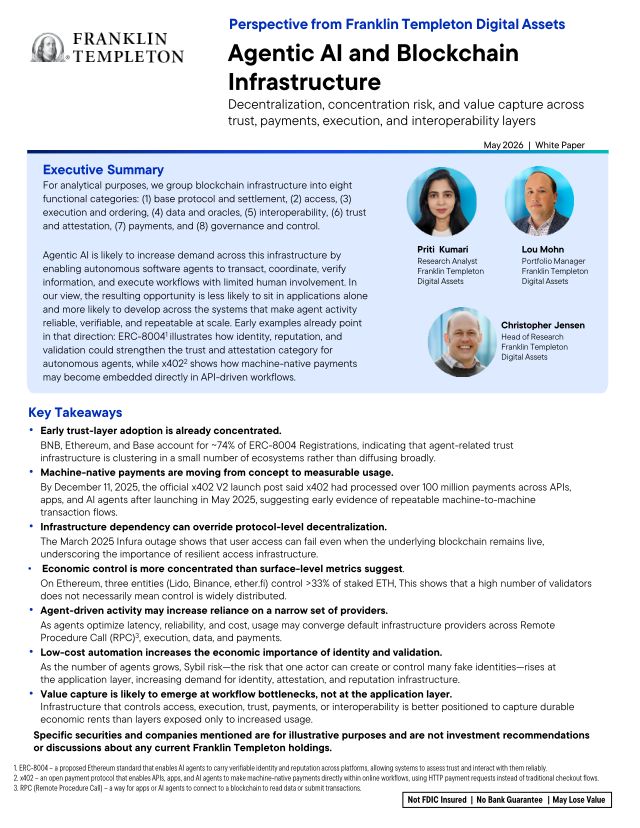
Agentic AI and Blockchain Infrastructure

Sách trắng của Franklin Templeton Digital Assets (5/2026) chia hạ tầng blockchain thành tám nhóm chức năng (giao thức nền, truy cập, thực thi, dữ liệu/oracle, liên thông, tin cậy/xác thực, thanh toán, quản trị) và phân tích AI dạng agent sẽ làm tăng nhu cầu ở đâu. Giá trị có thể nằm ở hạ tầng giúp hoạt động của agent đáng tin và lặp lại được, hơn là ở ứng dụng. Ví dụ: chuẩn ERC-8004 cho danh tính và uy tín agent, và giao thức x402 cho thanh toán máy–máy (hơn 100 triệu giao dịch tới 12/2025). Rủi ro: hoạt động của agent có thể dồn vào ít nhà cung cấp, như BNB, Ethereum, Base chiếm 74% đăng ký ERC-8004, và ba thực thể kiểm soát hơn 33% ETH được stake.Franklin Templeton Digital Assets' white paper (May 2026) groups blockchain infrastructure into eight functions (base protocol, access, execution, data/oracles, interoperability, trust/attestation, payments, governance) and analyses where agentic AI will raise demand. Value is likely to accrue to the infrastructure that makes agent activity reliable and repeatable rather than to applications. Examples: ERC-8004 for agent identity and reputation, and x402 for machine-to-machine payments (over 100m payments by Dec 2025). The risk is concentration: BNB, Ethereum and Base hold 74% of ERC-8004 registrations, and three entities control over 33% of staked ETH.

Agentic AIBlockchainx402Machine PaymentsConcentration Risk
RWA Phát hành ~2025Released ~2025 · Finzly · ĐăngPosted

Surround, Shrink, Scale: The Legacy Exit Strategy for Payment Modernization

Whitepaper của Finzly (nhà cung cấp phần mềm thanh toán) đề xuất chiến lược “Bao quanh, Thu nhỏ, Mở rộng” (Surround, Shrink, Scale) để ngân hàng thoát khỏi hệ thống thanh toán cũ mà không gián đoạn hoạt động. Thay vì thay thế toàn bộ, ngân hàng đặt một lớp điều phối thanh toán bao quanh hệ thống cũ, chuyển dần từng chức năng sang nền tảng mới, rồi mở rộng. Bối cảnh: giá trị thanh toán số toàn cầu dự kiến đạt 36,8 nghìn tỷ USD năm 2029 (tăng trưởng 15,9%/năm), thị trường Bắc Mỹ từ 3,2 lên 6,9 nghìn tỷ USD; trong khi hạ tầng xử lý theo lô của ngân hàng trở thành gánh nặng chi phí, rủi ro gian lận và tuân thủ.Payments-software vendor Finzly proposes a “Surround, Shrink, Scale” strategy for banks to exit legacy payment systems without disrupting operations. Instead of a full replacement, banks wrap legacy systems with a payment orchestration layer, migrate functions gradually, then scale. Context: global digital payment value is forecast at USD 36.8tn by 2029 (15.9% CAGR) and North America from USD 3.2tn to 6.9tn, while banks' batch-based infrastructure has become a cost, fraud and compliance liability.

PaymentsPayment ModernizationOrchestrationReal-time PaymentsISO 20022
RWA Phát hành 09/2026Released 09/2026 · Financial Conduct Authority (UK) · ĐăngPosted

Powering open finance infrastructure (Smart Data Accelerator research)

Nghiên cứu do Smart Data Accelerator của FCA đặt hàng (Saïd Business School, Đại học Oxford và Raidiam), công bố 29/09/2026, so sánh ba mô hình hạ tầng để mở rộng từ ngân hàng mở (open banking) sang tài chính mở (open finance): tập trung, phi tập trung/liên bang và lai. Dựa trên kinh nghiệm của Brazil, Úc, EU và UAE, nghiên cứu cho rằng mô hình lai là đề xuất đáng tin cậy để thử nghiệm tại Anh: điều phối tập trung các chức năng cần nhất quán như cấp chứng nhận và niềm tin, trong khi cho phép doanh nghiệp linh hoạt cung cấp dịch vụ. Khi dịch vụ AI tác tử hành động thay người dùng, hạ tầng cần xác lập danh tính, thẩm quyền và hành động được phép của dịch vụ đó.Research commissioned by the FCA's Smart Data Accelerator (Saïd Business School, University of Oxford, and Raidiam), published 29 Sep 2026, compares three infrastructure models for scaling from open banking to open finance: centralised, decentralised/federated and hybrid. Drawing on Brazil, Australia, the EU and the UAE, it finds a hybrid a credible proposition for UK testing: centrally coordinate functions needing consistency, such as accreditation and trust, while giving firms flexibility in service delivery. As AI agents act for users, infrastructure must establish the service's identity, authority and permitted actions.

Open FinanceData SharingAgentic AIRegulationInfrastructure
RWA Phát hành 09/2026Released 09/2026 · European University Institute, Robert Schuman Centre (Andrew Whitworth) · ĐăngPosted

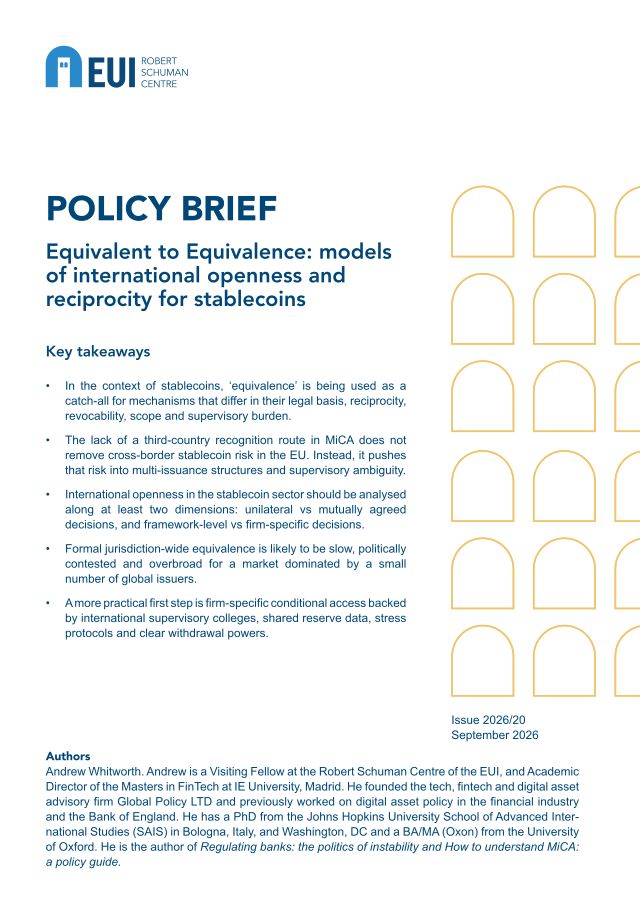
Equivalent to Equivalence: models of international openness and reciprocity for stablecoins (EUI Policy Brief 2026/20)

Policy brief của Andrew Whitworth (EUI) phân tích việc các khung stablecoin (MiCA của EU, GENIUS Act của Mỹ, chế độ của Anh) đã gần hoàn thiện nhưng không “nói chuyện” với nhau: stablecoin hợp pháp ở EU không thể tự do lưu hành ở Mỹ hay Anh và ngược lại. Thuật ngữ “tương đương” (equivalence) đang bị dùng chung cho nhiều cơ chế khác nhau về cơ sở pháp lý, tính có đi có lại, khả năng thu hồi và gánh nặng giám sát. Việc MiCA thiếu con đường công nhận nước thứ ba không loại bỏ rủi ro xuyên biên giới mà đẩy rủi ro vào cấu trúc đa tổ chức phát hành. Tác giả đề xuất bước đầu thực tế: cho phép tiếp cận có điều kiện theo từng tổ chức phát hành, dựa trên hội đồng giám sát quốc tế, chia sẻ dữ liệu dự trữ, quy trình xử lý căng thẳng và quyền rút lại rõ ràng.Andrew Whitworth's EUI policy brief argues stablecoin frameworks (EU MiCA, US GENIUS Act, UK regime) are nearly complete but do not talk to each other: an EU-lawful stablecoin cannot freely circulate in the US or UK and vice versa. “Equivalence” is used loosely for mechanisms differing in legal basis, reciprocity, revocability, scope and supervisory burden. MiCA's lack of a third-country route does not remove cross-border risk; it pushes it into multi-issuance structures. The practical first step proposed: firm-specific conditional access backed by international supervisory colleges, shared reserve data, stress protocols and clear withdrawal powers.

StablecoinsEquivalenceMiCACross-border RegulationGENIUS Act
RWA Phát hành 09/2026Released 09/2026 · European System of Central Banks (ECB) · ĐăngPosted

ESCB response to the European Commission's targeted consultation on the Markets in Crypto-Assets Regulation (MiCAR)

Phản hồi 57 trang của Hệ thống Ngân hàng Trung ương châu Âu (ESCB) cho đợt tham vấn rà soát MiCA của Uỷ ban châu Âu. ESCB đánh giá MiCA là khung vững chắc, nhưng đề xuất: giữ lệnh cấm trả lãi cho stablecoin; thay yêu cầu tiền gửi tối thiểu tại ngân hàng bằng “nhóm thanh khoản” (tỷ lệ tài sản đáo hạn trong 1 và 5 ngày làm việc); tăng yêu cầu vốn và đa dạng hoá dự trữ với tổ chức phát hành phi ngân hàng; làm rõ pháp lý về mô hình stablecoin đa tổ chức phát hành với nước thứ ba; mở rộng quyền đưa ý kiến của ECB về ổn định tài chính. ESCB cũng ủng hộ chuyển quyền cấp phép và giám sát mọi CASP sang ESMA, và bàn các chủ đề ngoài MiCA như DeFi, staking, cho vay và tiền gửi token hoá.The European System of Central Banks' 57-page response to the Commission's MiCA review consultation. The ESCB calls MiCA robust but proposes: keep the ban on stablecoin interest; replace minimum bank-deposit requirements with liquidity buckets (shares of assets maturing within one and five working days); raise own funds and reserve diversification for non-bank issuers; clarify the legality of third-country multi-issuer stablecoin schemes; and extend ECB opinion powers on financial stability. It supports moving authorisation and supervision of all CASPs to ESMA, and addresses topics beyond MiCA: DeFi, staking, lending and tokenised deposits.

MiCAStablecoinsRegulationTokenised DepositsDeFi
RWA Phát hành 10/2026Released 10/2026 · European Central Bank · ĐăngPosted

Central banks on-chain (presentation by Isabel Schnabel)

Bài trình bày của Isabel Schnabel (Ban Điều hành ECB) ngày 01/10/2026 tại hội nghị Future of Money để vinh danh Charles Goodhart (Ngân hàng Anh). Token hoá cho phép thanh toán nhanh, an toàn và thông minh hơn nhờ khả năng lập trình và tính nguyên tử (các vế giao dịch cùng thanh toán hoặc cùng không). Hệ thống tiền tệ hiện đại dựa trên cấu trúc hai tầng, với tiền ngân hàng trung ương làm neo, và có thể mở rộng thanh khoản linh hoạt khi khủng hoảng (ví dụ 1907, COVID-19). ECB muốn giữ vai trò neo này trong thế giới token hoá: Pontes ra mắt 21/09/2026 với mô hình thanh toán kép qua TARGET hoặc DLT, còn Appia khám phá các kiến trúc token hoá dài hạn.Isabel Schnabel (ECB Executive Board) spoke on 1 Oct 2026 at the Future of Money conference honouring Charles Goodhart (Bank of England). Tokenisation enables faster, safer, smarter settlement through programmability and atomicity (all legs settle together or not at all). Modern monetary systems rest on a two-tier structure anchored by central bank money, which can expand liquidity elastically in crises (1907, COVID-19). The ECB aims to preserve this anchor in a tokenised world: Pontes launched on 21 Sep 2026 with dual settlement via TARGET or DLT, while Appia explores long-term tokenised architectures.

Tokenised Central Bank MoneyPontesAppiaTwo-tier Monetary SystemProgrammability
RWA Phát hành 09/2026Released 09/2026 · European Central Bank · ĐăngPosted

The digitalisation of money, payments and finance (presentation by Piero Cipollone)

Bài trình bày của Piero Cipollone (Ban Điều hành ECB) ngày 23/09/2026 tại Fondazione ResPublica tóm tắt chiến lược thanh toán toàn diện của ECB. Hai trụ cột cung cấp tiền ngân hàng trung ương theo cách mới: euro kỹ thuật số cho thanh toán bán lẻ hằng ngày (bổ sung tiền mặt, có giới hạn nắm giữ, không trả lãi, phân phối qua ngân hàng) và tiền ngân hàng trung ương token hoá cho giao dịch bán buôn qua dự án Pontes và Appia. ECB phân loại tài sản thanh toán số thành tài sản công (euro số, Pontes/Appia) và tài sản tư (tiền gửi token hoá, stablecoin). Thí điểm euro số kéo dài 12 tháng bắt đầu nửa cuối 2027, mục tiêu sẵn sàng phát hành năm 2029.Piero Cipollone (ECB Executive Board) presented the ECB's payments strategy on 23 Sep 2026 at Fondazione ResPublica. Two pillars supply central bank money in new ways: the digital euro for everyday retail payments (complementing cash, with holding limits, no remuneration, distributed by banks) and tokenised central bank money for wholesale via Pontes and Appia. The ECB classifies digital settlement assets as public (digital euro, Pontes/Appia) and private (tokenised deposits, stablecoins). A 12-month digital euro pilot starts in H2 2027, with readiness for potential first issuance in 2029.

Digital EuroTokenised Central Bank MoneyPontesAppiaPayments Strategy
RWA Phát hành 09/2026Released 09/2026 · European Banking Authority · ĐăngPosted

EBA Work Programme 2027 (EBA/REP/2026/18)

Chương trình làm việc 2027 của Cơ quan Ngân hàng châu Âu (EBA) đặt trọng tâm vào một môi trường biến động và số hoá hơn. EBA gánh thêm trách nhiệm mới: giám sát chính 19 nhà cung cấp dịch vụ ICT trọng yếu theo DORA, giám sát tổ chức phát hành token crypto quan trọng theo MiCA, và phê duyệt mô hình ký quỹ ban đầu theo EMIR. Về tài sản số, EBA sẽ mở rộng phân tích tài sản thanh toán token hoá sang sản phẩm đầu tư token hoá do ngân hàng EU cung cấp, theo dõi việc dùng ART và EMT trong DeFi (gồm cho vay), hỗ trợ Uỷ ban châu Âu rà soát MiCA, và bắt đầu phân tích AI tác tử trong thanh toán phục vụ triển khai PSD3/PSR.The European Banking Authority's 2027 work programme focuses on a more volatile and digital environment. The EBA takes on new roles: lead overseer of 19 critical ICT third-party providers under DORA, supervisor of significant crypto-token issuers under MiCA, and validator of initial margin models under EMIR. On digital assets, it will extend tokenised-settlement-asset analysis to tokenised investment products offered by EU banks, monitor ART/EMT use in DeFi (including lending), support the Commission's MiCA review, and begin analysing agentic AI in payments for PSD3/PSR implementation.

RegulationMiCADORATokenisationEU Banking
RWA Phát hành ~2026Released ~2026 · DTCC · ĐăngPosted

Collateral Infrastructure for Tokenized Capital Markets: Just-in-Time Mobility, Capital Efficiency and Market Resilience

Sách trắng của DTCC cho rằng nút thắt của thị trường vốn token hoá không còn là tạo token mà là di chuyển tài sản đảm bảo. Collateral AppChain của DTCC được giới thiệu như lớp hạ tầng dùng chung để chuyển tài sản truyền thống token hoá và tài sản số giữa các quy trình cấp vốn, ký quỹ và quyết toán. Mục tiêu là chuyển từ giữ tài sản đảm bảo “phòng khi cần” sang dùng “đúng lúc cần”, giảm vùng đệm thanh khoản và chi phí vốn, cải thiện các chỉ số LCR và SA-CCR. Repo trong ngày là trường hợp dùng rõ nhất. Tài liệu dẫn: Broadridge DLR đạt 368 tỷ USD/ngày (11/2025), DTC nhận thư không phản đối của SEC cho dịch vụ token hoá, Hồng Kông phát hành 1,3 tỷ USD trái phiếu số.DTCC's white paper argues the bottleneck in tokenised capital markets is no longer token creation but collateral mobility. DTCC's Collateral AppChain is positioned as shared infrastructure to move tokenised traditional and digital assets across financing, margin and settlement. The aim is to shift collateral from just-in-case to just-in-time, cutting liquidity buffers and funding drag and improving LCR and SA-CCR outcomes. Intraday repo is the clearest use case. It cites Broadridge DLR at USD 368bn a day (Nov 2025), an SEC no-action letter for DTC's tokenisation service, and Hong Kong's USD 1.3bn digital bond.

CollateralRepoDTCCTokenized AssetsCapital Efficiency
RWA Phát hành ~Q1/2026Released ~Q1 2026 · The International Economy (Burkhard Drees, Sunil Sharma) · ĐăngPosted

Forget Stablecoins: Why central bank digital currency is the only monetary foundation that will work

Bài viết của hai cựu chuyên gia IMF Burkhard Drees và Sunil Sharma trên tạp chí The International Economy (Mùa đông 2026). Các cuộc khủng hoảng tài chính lớn đều có điểm chung: tiền tư nhân thất bại, từ các vụ rút tiền ngân hàng những năm 1930, quỹ thị trường tiền tệ năm 2008 đến stablecoin sụp đổ năm 2022. Ngân hàng vừa tạo tiền vừa cho vay rủi ro là “tội tổ tông” khiến hệ thống vừa không thể thiếu vừa mong manh. Stablecoin chỉ thêm một lớp công cụ dễ bị rút tiền ồ ạt. Tác giả đề xuất lấy CBDC làm nền tiền tệ: ngân hàng trung ương cho các tổ chức tín dụng vay CBDC, còn quyết định cho vay cụ thể vẫn do thị trường.An essay by former IMF economists Burkhard Drees and Sunil Sharma in The International Economy (Winter 2026). Every major modern crisis shares one thread: private money failed, from 1930s bank runs to money market funds in 2008 and stablecoins in 2022. Banks' dual role of creating money and financing risky loans is the original sin that makes them indispensable and fragile. Stablecoins only add new runnable instruments. The authors propose CBDC as the monetary foundation: the central bank lends CBDC broadly to credit institutions while individual lending decisions stay decentralised.
CBDCStablecoinsMonetary PolicyFinancial StabilityNarrow Banking
RWA Phát hành 05/2026Released 05/2026 · Deutsche Bank Corporate Bank · ĐăngPosted

Digital Money – a perspective on stablecoins, tokenised deposits, and CBDCs

Bài phân tích của Deutsche Bank Corporate Bank (5/2026) về ba dạng tiền số: stablecoin, tiền gửi token hoá và CBDC, và ý nghĩa với định chế tài chính, thủ quỹ doanh nghiệp và mô hình lưu ký. Stablecoin USD chiếm gần như toàn bộ thị trường (khoảng 278 tỷ USD, so với 444 triệu USD stablecoin euro). Khung pháp lý đang rõ dần: GENIUS Act (7/2025) ở Mỹ, MiCAR áp dụng đầy đủ từ 12/2024 ở EU, Pháp lệnh Stablecoin của Hồng Kông có hiệu lực 1/8/2025, MAS tham vấn quy tắc mới. Tiền gửi token hoá phát triển theo ba mô hình: nền tảng một ngân hàng, đa ngân hàng (Partior, Swift Ledger, Agorá) và trên blockchain công khai. CBDC bán lẻ ít được dùng, còn CBDC bán buôn đang chuyển từ khái niệm sang triển khai.Deutsche Bank Corporate Bank's paper (May 2026) on three forms of digital money (stablecoins, tokenised deposits and CBDCs) and what they mean for financial institutions, corporate treasuries and custody. USD stablecoins dominate (about USD 278bn versus USD 444m in euro stablecoins). Rules are clarifying: the GENIUS Act (July 2025) in the US, MiCAR fully applicable since Dec 2024 in the EU, Hong Kong's Stablecoins Ordinance from 1 Aug 2025, and MAS consultations. Tokenised deposits follow three models: single-bank, multi-bank (Partior, Swift Ledger, Agorá) and on public chains. Retail CBDCs see little uptake, while wholesale CBDCs move from concept to implementation.

StablecoinsTokenized DepositsCBDCCorporate TreasuryCustody
RWA Phát hành 09/2026Released 09/2026 · Deutsche Bank (Corporate Bank) · ĐăngPosted

Cross-border payments in 2040: five hypotheses for a multi-rail future

Deutsche Bank đưa ra năm giả thuyết cho thanh toán xuyên biên giới đến năm 2040. (1) Nghịch lý đồng đô la: dự trữ đa dạng hoá (chủ yếu sang vàng) nhưng thanh toán vẫn dựa vào USD. (2) Giả định hội tụ sụp đổ: mạng thanh toán phân mảnh theo địa chính trị và quy định. (3) Mở rộng hạ tầng sẵn có, như mô hình One-Leg-Out và chuẩn thanh toán của Swift. (4) Tiền token hoá đi từ thử nghiệm sang nền tảng; tiền gửi token hoá và stablecoin bổ sung cho nhau chứ không cạnh tranh. (5) AI dịch chuyển giá trị từ thực thi sang điều phối thanh toán. Kết luận: giá trị của ngân hàng đại lý nằm ở khả năng kết nối các hệ sinh thái khác nhau, không ở việc sở hữu một rail.Deutsche Bank sets out five hypotheses for cross-border payments to 2040. (1) The dollar paradox: reserves diversify (mainly into gold) while payments stay dollar-led. (2) The convergence assumption breaks as networks fragment along geopolitical and regulatory lines. (3) Scale what already runs, e.g. One-Leg-Out and the Swift payments scheme. (4) Tokenized money moves from pilots to platforms; tokenized deposits and stablecoins are complementary, not competing. (5) AI shifts value from execution to orchestration. Conclusion: correspondent banking's value lies in connecting ecosystems, not owning a rail.

Cross-border PaymentsCorrespondent BankingTokenized DepositsStablecoinsDollar
RWA Phát hành 09/2026Released 09/2026 · Deutsche Bank Research Institute · ĐăngPosted

Asset Tokenization 101: The Next Phase of Financial Infrastructure

Chartbook của Deutsche Bank Research (Marion Laboure, Camilla Siazon) cho thấy thị trường tài sản token hoá (không tính stablecoin) tăng từ ~10 tỷ USD (01/2025) lên ~39 tỷ USD (09/2026), dẫn đầu là trái phiếu kho bạc Mỹ (~15 tỷ USD) qua các quỹ thị trường tiền tệ token hoá. Token hoá đang mở rộng từ tài sản sang hạ tầng: dịch vụ token hoá của DTCC (ra mắt 10/2026), repo trong ngày trên DLT, và giải pháp Pontes của Eurosystem. Tuy vậy, phát hành token không tự tạo ra thanh khoản thứ cấp; cần đồng thời tiến bộ về tài sản, tiền thanh toán và hạ tầng.Deutsche Bank Research's chartbook (Marion Laboure, Camilla Siazon) shows tokenized assets excluding stablecoins growing from ~USD 10bn (Jan 2025) to ~USD 39bn (Sep 2026), led by US Treasuries (~USD 15bn) via tokenized money market funds. Tokenization is moving from assets to infrastructure: DTCC's tokenization service (launching Oct 2026), DLT intraday repo and the Eurosystem's Pontes. But issuance does not automatically create secondary liquidity; progress is needed on assets, settlement money and infrastructure together.

TokenizationTokenized TreasuriesMoney Market FundsTokenized EquitiesPrivate Credit
RWA Phát hành 06/2026Released 06/2026 · CV VC (Olaf Hannemann, Janis Aguilar) · ĐăngPosted

The Digital Finance Stack: Where Early-Stage Capital Should Play

Bài tư duy của CV VC (6/2026), quỹ đầu tư mạo hiểm tập trung blockchain tại châu Âu, về việc định chế tài chính lớn đã vào tài sản số ở quy mô sản xuất, và điều đó có ý nghĩa gì với nhà đầu tư giai đoạn sớm. Khối lượng giao dịch tài sản số lên tới hàng nghìn tỷ USD, RWA token hoá tăng hơn 200% mỗi năm, và token quyết toán cấp ngân hàng đã chạy trên blockchain công khai. Không phải việc gì ngân hàng làm cũng là cơ hội cho startup; cần tìm khoảng trống mà các ông lớn không ưu tiên hoặc không làm nhanh được. Ba lĩnh vực CV VC tin tưởng: hạ tầng tuân thủ gốc blockchain, hạ tầng thanh toán theo ngành dọc (hành lang nhân đạo, thương mại số châu Phi, kinh tế sáng tạo), và giải quyết bài toán niềm tin.A thought paper by CV VC (June 2026), a Europe-based blockchain venture fund, on what institutional adoption of digital assets at production scale means for early-stage investors. Digital-asset volumes are in the trillions, tokenised RWAs grow over 200% a year, and bank-grade settlement tokens run on public chains. Not everything banks do is a startup opportunity; the task is to find white space incumbents will not prioritise or reach fast. CV VC's three conviction areas: blockchain-native compliance infrastructure, vertical payment infrastructure (humanitarian corridors, African digital commerce, the creator economy), and solving trust problems.

Venture CapitalDigital FinanceCompliancePaymentsEmerging Markets
RWA Phát hành ~Q2/2026Released ~Q2 2026 · CRIF · ĐăngPosted

Banking on Banks 2026: Financial services in an age of uncertainty

Báo cáo thường niên Banking on Banks của CRIF (công ty thông tin tín dụng), năm nay khảo sát 5.000 người tiêu dùng và lần đầu thêm 500 lãnh đạo doanh nghiệp tại Anh, Ireland, Ý, Đức và Ba Lan (thực hiện bởi Opinium, tháng 3–4/2026). Bối cảnh: xung đột Trung Đông đẩy giá dầu trên 100 USD/thùng, lạm phát dai dẳng và thị trường kỳ vọng ECB tăng lãi suất. 78% người châu Âu lo lắng về tài chính 12 tháng tới (năm trước 74%), 50% định cắt giảm chi tiêu; 81% doanh nghiệp có ít nhất một mối lo tài chính lớn. Ngân hàng được coi là thiết yếu nhưng chưa được tin là đáp ứng được: chỉ 29% người tiêu dùng thấy nhà cung cấp làm đủ để hỗ trợ, 55% doanh nghiệp lo về sức chống chịu của ngân hàng châu Âu. Gian lận dùng AI là mối lo lớn: 71% người tiêu dùng lo AI tạo ra hình thức lừa đảo mới (năm trước 25%). Báo cáo không đề cập tài sản số hay token hoá.CRIF's (a credit information firm) annual Banking on Banks report, this year surveying 5,000 consumers and, for the first time, 500 business leaders in the UK, Ireland, Italy, Germany and Poland (by Opinium, March–April 2026). Context: Middle East conflict pushing oil above USD 100 a barrel, sticky inflation and markets pricing ECB hikes. 78% of Europeans worry about their finances over the next 12 months (74% last year) and 50% plan to cut spending; 81% of businesses have at least one major financial concern. Banks are seen as essential but not trusted to deliver: only 29% of consumers think providers do enough to support them, and 55% of businesses worry about European banks' resilience. AI-enabled fraud is a major worry: 71% of consumers fear AI is creating new kinds of fraud (25% were worried about AI risks last year). The report does not cover digital assets or tokenization.

BankingConsumer SurveyTrustFraudEurope
RWA Phát hành 06/2026Released 06/2026 · Commonwealth Bank of Australia (CommBank) · ĐăngPosted

2026 digital currency and tokenisation update

Bài phân tích của CommBank (22/6/2026) về việc tiền số và token hoá chuyển từ thí điểm sang sản xuất. Tiền số có ba dạng: stablecoin, token tiền gửi và CBDC; tính lập trình và giao dịch “nguyên tử” giúp thanh toán nhanh và rẻ hơn, nhất là xuyên biên giới. Ước tính số hoá tài chính như token hoá có thể tạo khoảng 4 nghìn tỷ USD hiệu quả mỗi năm trên toàn cầu, trong đó khoảng 24 tỷ USD/năm cho Úc. Năm 2026 được xem là năm bứt phá của Úc khi luật tài sản số đầu tiên đã được thông qua và sẽ có thêm luật, giúp Úc bắt kịp EU, Mỹ, Hồng Kông và Singapore. Các chuyên gia CommBank và Trung tâm DFCRC dự báo nhiều dạng tiền sẽ cùng tồn tại.CommBank's note (22 June 2026) on digital currencies and tokenisation moving from pilots to production. Digital money takes three forms: stablecoins, deposit tokens and CBDCs; programmability and atomic settlement make payments faster and cheaper, especially across borders. Digital finance such as tokenisation could deliver about USD 4tn in global efficiency gains a year, including about USD 24bn a year for Australia. 2026 is billed as Australia's breakthrough year: initial digital-asset legislation has passed with more to come, bringing Australia closer to the EU, US, Hong Kong and Singapore. CommBank and DFCRC experts expect multiple forms of money to coexist.

AustraliaDigital CurrencyDeposit TokensStablecoinsCBDC
RWA Phát hành ~Q3/2026Released ~Q3 2026 · Citi Investor Services & The ValueExchange · ĐăngPosted

Digital Collateral: a practical reality

Citi và The ValueExchange tập hợp các tình huống thực tế cho thấy token hoá tài sản đảm bảo đã trở thành hiện thực: khoảng 346 tỷ USD repo mỗi ngày dùng chứng khoán token hoá, và 27% tổ chức dự định cầm cố trái phiếu và tiền token hoá trong năm 2027. Vấn đề cốt lõi: hạ tầng cũ chỉ chạy giờ hành chính, trong khi rủi ro không ngủ, nên các bên phải ký quỹ thừa và cấp vốn trước. Các tình huống gồm ký quỹ 24/7, CCP châu Á tận dụng đồng hồ 24 giờ, quỹ MMF token hoá của Franklin Templeton làm tài sản đảm bảo lý tưởng, Citi Wealth đưa crypto vào chuỗi tài trợ, phát hành chứng khoán tiền IPO của SIX và kinh nghiệm của quỹ QRT.Citi and The ValueExchange compile case studies showing tokenized collateral is now real: about USD 346bn of daily repo uses tokenized securities, and 27% of institutions plan to pledge tokenized bonds and cash in 2027. The core problem: legacy infrastructure runs in business hours while risk never sleeps, forcing over-collateralization and pre-funding. Cases cover 24x7 margining, Asian CCPs using the 24-hour clock, Franklin Templeton's tokenized MMF as ideal collateral, Citi Wealth bringing crypto into the funding chain, SIX's pre-IPO securities issuance and lessons from trading firm QRT.

CollateralTokenized MMFsMarginCCPsRepo
RWA Phát hành 09/2026Released 09/2026 · Citi (co-authored with Swift) · ĐăngPosted

The Connective Tissue of Digital Finance: Interoperability, Programmability, and the Path to Institutional Scale

Citi (đồng tác giả với Swift) cho rằng nút thắt của tài chính số không còn là công nghệ mà là khả năng tương tác. Ngân hàng đã đầu tư hơn 100 tỷ USD vào blockchain từ 2020, tạo ra nhiều mạng song song với thanh khoản phân mảnh, giống thời điện thoại sơ khai khi mỗi nhà mạng là một hòn đảo. Giai đoạn tới là môi trường lai: tài sản, tiền và sổ sách nằm trên hệ thống cũ, sổ cái riêng và blockchain công khai. Khả năng tương tác giúp tài sản di chuyển, còn khả năng lập trình giúp tài sản mang theo quy tắc, nghĩa vụ và tuân thủ khi di chuyển. Báo cáo đánh giá cạnh tranh giữa các loại tiền thanh toán (tiền gửi token hoá, stablecoin, tiền ngân hàng trung ương) và coi quy định là một tính năng, không chỉ là ràng buộc.Citi (co-authored with Swift) argues the bottleneck in digital finance is interoperability, not technology. Banks have invested over USD 100bn in blockchain since 2020, producing parallel networks with fragmented liquidity, like early telephone companies running isolated networks. The near term is hybrid: assets, cash and records across legacy systems, private ledgers and public chains. Interoperability lets assets move; programmability lets them carry their rules, obligations and compliance as they move. The paper assesses competition among settlement monies (tokenized deposits, stablecoins, central bank money) and frames regulation as a feature, not just a constraint.

InteroperabilityProgrammabilityTokenized DepositsSettlementSwift
RWA Phát hành ~Q3/2026Released ~Q3 2026 · Centrifuge · ĐăngPosted

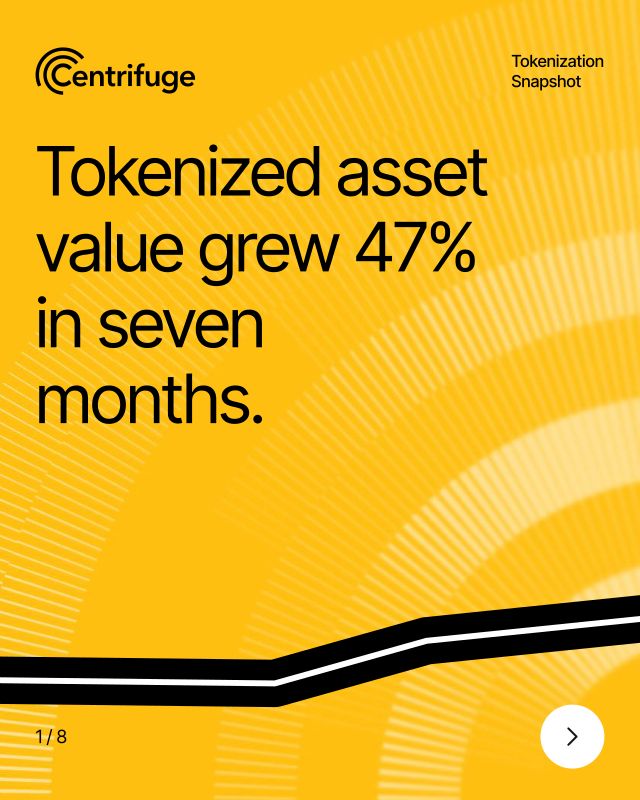
Tokenization Snapshot: Tokenized asset value grew 47% in seven months

Bản snapshot 8 trang của Centrifuge (dữ liệu RWA.xyz) cho thấy giá trị tài sản token hoá phân phối tăng từ 25,4 tỷ lên 37,5 tỷ USD (+47%) trong 7 tháng đầu 2026, ngay cả khi bitcoin giảm 28,8% và ethereum giảm 38%. Số người nắm giữ tăng 148% (lên 1,53 triệu), cho thấy sở hữu đang lan rộng ra ngoài nhóm tổ chức lớn. Thị trường có hai loại cầu: ví trái phiếu kho bạc token hoá trung bình 257.000 USD (tổ chức) và ví cổ phiếu token hoá trung bình 2.135 USD (cá nhân). RWA gửi vào DeFi tăng gấp ba lên 7,4 tỷ USD, chiếm 6% tiền gửi DeFi.Centrifuge's 8-page snapshot (RWA.xyz data) shows distributed tokenized-asset value rising from USD 25.4bn to USD 37.5bn (+47%) in the first seven months of 2026, even as bitcoin fell 28.8% and ether 38%. Holders grew 148% (to 1.53mn), showing ownership broadening beyond large allocators. Two demand types coexist: tokenized Treasury wallets average USD 257k (institutions) and tokenized stock wallets USD 2,135 (individuals). RWAs deposited in DeFi tripled to USD 7.4bn, 6% of DeFi deposits.

TokenizationTokenized TreasuriesTokenized StocksDeFiMarket Data
AI Phát hành 04/2026Released 04/2026 · Cambridge Centre for Alternative Finance (CCAF) & partners · ĐăngPosted

The 2026 Global AI in Financial Services Report: Adoption, impact and risks

Báo cáo khảo sát toàn cầu của CCAF (Đại học Cambridge, 4/2026) cùng BIS, IMF, WEF, Ngân hàng Thế giới và nhiều đối tác về việc áp dụng AI trong tài chính, khảo sát ba nhóm: định chế tài chính, nhà cung cấp AI và cơ quan quản lý. AI đã thành thành phần cấu trúc của ngành, chuyển từ học máy cổ điển sang AI tạo sinh và agent. Đa số xây quy trình trên mô hình nền bên ngoài (63% doanh nghiệp, 65% cơ quan quản lý); OpenAI được dùng nhiều nhất (76% doanh nghiệp), tiếp theo là Google và Anthropic. 40% cho biết AI tăng lợi nhuận, 43% chưa thấy thay đổi; giá trị tập trung ở định chế đầu tư nhiều và fintech. Rủi ro hàng đầu là quyền riêng tư dữ liệu và “ảo giác” của mô hình; cơ quan quản lý thừa nhận chưa đầu tư đủ cho năng lực giám sát.CCAF's global survey report (University of Cambridge, April 2026), with the BIS, IMF, WEF, World Bank and others, on AI adoption in finance across three groups: financial institutions, AI vendors and regulators. AI has become a structural part of the industry, moving from classical machine learning to generative and agentic AI. Most build on external foundation models (63% of industry, 65% of regulators); OpenAI is most used (76% of industry), followed by Google and Anthropic. 40% report higher profitability from AI and 43% no change; value concentrates in high-investment institutions and fintechs. Top risks are data privacy and model hallucinations; regulators admit supervisory capacity is under-funded.

AI AdoptionFinancial ServicesRegulatorsSurveyAI Risks
RWA Phát hành 06/2026Released 06/2026 · Cambridge Centre for Alternative Finance (CCAF) & Fii · ĐăngPosted

Competition in Digital Financial Services: Regulatory Strategies and Pathways for Emerging Markets and Developing Economies

Báo cáo của CCAF và Fii (6/2026, tài trợ bởi FCDO Anh) về cách cơ quan quản lý ở các nước đang phát triển thúc đẩy cạnh tranh trong dịch vụ tài chính số và qua đó hỗ trợ huy động vốn tư nhân. Báo cáo đề xuất khung bốn tầng: hạ tầng và khung pháp lý nền; công cụ hỗ trợ gia nhập; công cụ hỗ trợ mở rộng; công cụ định hình thị trường nâng cao. Hai nghiên cứu tình huống: Kenya và Nigeria; Malaysia và Việt Nam. Malaysia bắt buộc liên thông thanh toán sớm nên cạnh tranh tốt hơn; Việt Nam đi sau, chủ yếu tự nguyện, nên khó vượt qua tình trạng phân mảnh và hệ thống khép kín, hạn chế tác động tới cạnh tranh và hình thành vốn.CCAF and Fii's report (June 2026, funded by the UK FCDO) on how regulators in emerging economies can promote competition in digital financial services and, through it, private capital formation. It proposes a four-tier framework: foundational infrastructure and regulation; entry tools; scaling tools; advanced market-shaping tools. Two case studies: Kenya and Nigeria; Malaysia and Vietnam. Malaysia's early interoperability mandate fostered competition; Vietnam's later, largely voluntary approach struggled to overcome fragmentation and siloed systems, limiting the impact on competition and capital formation.

CompetitionDigital Financial ServicesInteroperabilityEmerging MarketsVietnam
RWA Phát hành 09/2026Released 09/2026 · Bank of England · ĐăngPosted

Money and power: lessons from history for stablecoins and US dollar dominance (speech by Carolyn Wilkins)

Bài phát biểu của Carolyn Wilkins (thành viên Uỷ ban Chính sách Tài chính, Ngân hàng Anh) ngày 15/09/2026 tại Queen's University Belfast dùng lịch sử tiền tư nhân để trả lời ba câu hỏi. (1) Tiền số tư nhân có vận hành an toàn ở quy mô lớn không? Có, nhưng chỉ khi thể chế bảo đảm quyền đổi lại đáng tin, giao dịch ngang giá và cơ chế xử lý khủng hoảng. (2) Nếu stablecoin USD mở rộng? Chúng mở rộng thanh toán bằng đô la, đẩy mạnh đô la hoá số và cầu tài sản an toàn Mỹ, nhưng cũng tạo rủi ro ổn định tài chính xuyên biên giới. (3) Quyền lực tiền tệ quốc tế? Công nghệ không tự bảo đảm vị thế đồng đô la; như bài học của đồng bảng Anh, nền tảng là uy tín tiền tệ, năng lực tài khoá, thị trường vốn sâu và pháp quyền.Carolyn Wilkins (Bank of England FPC member) spoke on 15 Sep 2026 at Queen's University Belfast, using the history of private money to answer three questions. (1) Can private digital money work safely at scale? Yes, but only with credible redemption, par exchange and stress-handling institutions. (2) If USD stablecoins scale? They extend dollar settlement, deepen digital dollarisation and demand for US safe assets, but create cross-border stability risks. (3) International monetary power? Technology cannot secure dollar dominance alone; as sterling showed, it rests on monetary credibility, fiscal capacity, deep capital markets and the rule of law.

StablecoinsDollar DominanceMonetary HistoryCentral BanksRegulation
RWA Phát hành ~Q3/2026Released ~Q3 2026 · BNY · ĐăngPosted

Modernizing the Payments Operating Model: From fragmented processes to a seamless 24/7 payments system

Whitepaper của BNY lập luận rằng hiện đại hoá thanh toán không còn là nâng cấp từng hệ thống (rail) riêng lẻ mà là thiết kế lại toàn bộ mô hình vận hành cho thế giới 24/7/365 với gần 100 hệ thống thanh toán thời gian thực, ISO 20022, tiền token hoá và AI. BNY giới thiệu Unified Payments Platform: một lớp điều phối không phụ thuộc rail, kết nối cả thanh toán truyền thống lẫn hệ sinh thái tiền số, đặt dữ liệu chuẩn hoá và “nhân viên số” dùng AI tác tử (agentic AI) làm nền tảng vận hành.BNY's whitepaper argues that payments modernization is no longer rail-by-rail upgrades but a redesign of the whole operating model for a 24/7/365 world with nearly 100 real-time rails, ISO 20022, tokenized money and AI. BNY presents its Unified Payments Platform: a rail-agnostic orchestration layer connecting traditional payments and digital-cash ecosystems, built on standardised data and agentic-AI “digital employees”.

Payments24/7 SettlementTokenized DepositsAgentic AIOperating Model
RWA Phát hành ~Q3/2026Released ~Q3 2026 · BlackRock · ĐăngPosted

The Machine-Native Economy: How digital assets connect intelligence, commerce, and compute

BlackRock lập luận rằng AI và tài sản số đang hội tụ: AI là “trí tuệ gốc máy”, còn tài sản số là “tiền gốc máy”. Ba điểm giao: (1) mô hình ngôn ngữ lớn và blockchain đều dùng kiến trúc token hoá để máy xử lý thông tin hoặc giá trị; (2) thương mại do AI tác tử thực hiện cần hạ tầng thanh toán lập trình được, chạy liên tục, xử lý giao dịch giá trị rất nhỏ, nơi stablecoin và giao thức như x402, ACP phù hợp hơn ACH hay thẻ; (3) năng lực tính toán (compute) có thể trở thành thị trường tài sản số lớn khi doanh thu đám mây hyperscaler có thể vượt 1.000 tỷ USD/năm vào 2030.BlackRock argues AI and digital assets are converging: AI is machine-native intelligence and digital assets are machine-native money. Three overlaps: (1) LLMs and blockchains share tokenization architectures that let machines process information or value; (2) agentic commerce needs programmable, always-on rails for tiny payments, where stablecoins and protocols such as x402 and ACP fit better than ACH or cards; (3) compute could become a large digital-asset market as hyperscaler cloud revenue may exceed USD 1tn a year by 2030.

Agentic AIStablecoinsMachine PaymentsComputeTokenization
RWA Phát hành 09/2026Released 09/2026 · Bitwise Asset Management · ĐăngPosted

Institutional Crypto Adoption: How leading institutional investors are thinking about and allocating to crypto assets

Bitwise phỏng vấn sâu 15 nhà phân bổ vốn cấp cao (quỹ tài trợ đại học, quỹ hưu trí công, quỹ đầu tư quốc gia, văn phòng gia đình, công ty niêm yết) trong tháng 3–4/2026. Ba phát hiện chính: bitcoin là tài sản niềm tin chung, thường được ghép với vàng; Ethereum và Solana chỉ là các khoản đặt cược công nghệ có điều kiện thoát. Vốn tổ chức “bám trụ”: dù giá giảm khoảng 50% từ 10/2025 đến 04/2026, không tổ chức nào giảm tỷ trọng. Rào cản còn lại là quản trị và danh tiếng, không phải giá trị đầu tư; tỷ trọng phổ biến 1–2% (dao động 0,5–13%).Bitwise interviewed 15 senior allocators (endowments, public pensions, sovereign funds, family offices, public companies) in March–April 2026. Three findings: bitcoin is the universal conviction asset, often paired with gold; Ethereum and Solana are thesis-dependent tech bets with exit gates. Institutional capital is sticky: despite a ~50% drop from Oct 2025 to Apr 2026, no institution cut its allocation. Remaining barriers are governance and reputation, not merit; allocations mostly 1–2% (range 0.5–13%).

Institutional InvestorsBitcoinAsset AllocationCrypto Markets
RWA Phát hành ~Q3/2026Released ~Q3 2026 · Bitwise Asset Management · ĐăngPosted

Crypto Market Review Q3 2026 (review of Q2 2026)

Báo cáo quý của Bitwise (60 trang) tổng kết quý 2/2026 là một quý khó khăn: chỉ số Bitwise 10 giảm 15,4%, quỹ ETF bitcoin giao ngay bị rút 4,9 tỷ USD (tệ nhất từ trước tới nay), giá giảm hơn 50% từ đỉnh tháng 10/2025 và là quý giảm thứ ba liên tiếp. Điểm sáng: tài sản thực token hoá đạt kỷ lục 33 tỷ USD (+45% từ đầu năm), khối lượng thị trường dự đoán đạt 43 tỷ USD, cổ phiếu crypto tăng 30,6%. CIO Matt Hougan nhận định thị trường đang định giá “mùa đông” cho một ngành đã lớn gấp đôi đáy chu kỳ trước.Bitwise's 60-page quarterly review calls Q2 2026 tough: the Bitwise 10 index fell 15.4%, spot bitcoin ETFs lost USD 4.9bn (their worst quarter), prices are down 50%+ from the October 2025 peak, and it was the third straight negative quarter. Bright spots: tokenized RWAs hit a record USD 33bn (+45% YTD), prediction-market volume reached USD 43bn, and crypto equities rose 30.6%. CIO Matt Hougan argues the market is pricing a winter for an industry twice the size of the last cycle's bottom.

Crypto MarketsBitcoin ETFTokenizationStablecoinsPrediction Markets
RWA Phát hành 09/2026Released 09/2026 · Bank for International Settlements (Aerts, Heijmans, Paulick, Vuletić) · ĐăngPosted

Hidden by complexity? Measuring stablecoin, crypto and decentralised finance ecosystems (BIS Working Paper No 1377)

Bài nghiên cứu của BIS và DNB chỉ ra nghịch lý của dữ liệu DeFi: mọi giao dịch đều công khai, nhưng rút ra ý nghĩa kinh tế lại rất khó. Dùng khoảng 100 tỷ bản ghi từ Bitcoin, Ethereum và Tron, các tác giả nêu ba nguồn sai lệch đo lường: cách cộng dồn giao dịch Bitcoin (UTXO), sự bùng nổ hợp đồng thông minh và token “rác” trên Ethereum, và việc cùng một stablecoin đóng vai trò khác nhau trên các chuỗi khác nhau. Kết luận: các chỉ số on-chain phổ biến (khối lượng, vốn hoá, TVL) chỉ nên xem là ước lượng nhiễu, cần báo cáo theo khoảng và giả định rõ ràng.This BIS–DNB paper highlights the DeFi data paradox: every transaction is public, yet deriving economic meaning is hard. Using about 100 billion records from Bitcoin, Ethereum and Tron, the authors identify three sources of measurement divergence: aggregating Bitcoin's UTXO transactions, smart-contract programmability and spurious token proliferation on Ethereum, and the same stablecoin serving different functions across chains. Conclusion: popular on-chain indicators (volume, market cap, TVL) are noisy approximations and should be reported as ranges with explicit assumptions.

StablecoinsDeFiMeasurementOn-chain dataCentral banks
RWA Phát hành 08/2026Released 08/2026 · Ulrich Bindseil & B. Duve (working paper) · ĐăngPosted

Tokenizing central bank money on public blockchains

Bindseil và Duve đề xuất một hướng ít được bàn: phát hành tiền ngân hàng trung ương dạng token trực tiếp trên blockchain công khai, bổ sung cho tiền mặt và CBDC truyền thống. Lý do: stablecoin tư nhân đang chiếm lớp thanh toán on-chain nhờ hạ tầng 24/7, khả năng kết hợp và hợp đồng thông minh, đe doạ chủ quyền tiền tệ và thúc đẩy đô la hoá. Dùng hạ tầng mở có thể rẻ hơn xây hệ thống riêng và giảm phụ thuộc nhà cung cấp; các tính năng blockchain hiện đại (danh sách trắng, quyền kiểm soát của tổ chức phát hành) giúp giảm rủi ro rửa tiền và ổn định tài chính. Tuy nhiên, giải pháp này không cứu được đồng tiền có chính sách tiền tệ thất bại.Bindseil and Duve propose an under-discussed route: issuing tokenized central bank money directly on public blockchains, alongside cash and conventional CBDC. The reason: private stablecoins are capturing the on-chain payment layer through 24/7 infrastructure, composability and smart contracts, threatening monetary sovereignty and fostering dollarization. Reusing open infrastructure could be cheaper than proprietary systems and reduce vendor lock-in; modern blockchain features (whitelists, issuer controls) can mitigate illicit-finance and stability risks. But it cannot save a currency with failed monetary policy.

Central Bank MoneyCBDCPublic BlockchainsStablecoinsMonetary Sovereignty
RWA Phát hành 05/2026Released 05/2026 · Boston Consulting Group (BCG) · ĐăngPosted

The Future of Digital Assets (BCG Flagship Report)

Báo cáo chủ lực của BCG (5/2026) dành cho lãnh đạo tài chính, chia tài sản số thành ba mảng: tiền số, RWA token hoá và crypto. Hiện crypto chiếm ưu thế (khoảng 3 nghìn tỷ USD vốn hoá, quỹ doanh thu khoảng 90 tỷ USD), stablecoin khoảng 300 tỷ USD, còn RWA token hoá công khai chỉ khoảng 30 tỷ USD. Trong kịch bản tích cực, RWA token hoá có thể đạt khoảng 16% tài sản đầu tư toàn cầu (khoảng 88 nghìn tỷ USD) vào 2035; trần tự nhiên của stablecoin khoảng 15% cung tiền M2 (khoảng 9 nghìn tỷ USD). Trong kịch bản số hoá nhanh, đến 2035 ngân hàng có thể có bảng cân đối nhỏ hơn 10%, doanh thu thấp hơn 14% và lợi nhuận thấp hơn 30%. BCG khuyên ngân hàng coi tài sản số là hạ tầng chiến lược.BCG's flagship report (May 2026) for financial executives splits digital assets into digital money, tokenised RWAs and crypto. Crypto dominates today (about USD 3tn market cap, about USD 90bn revenue pool), stablecoins are about USD 300bn and publicly visible tokenised RWAs only about USD 30bn. In a progressive scenario, tokenised RWAs could reach about 16% of global investable assets (about USD 88tn) by 2035; a natural ceiling for stablecoins is about 15% of M2 (about USD 9tn). In a rapid-digitisation scenario banks could see 10% smaller balance sheets, 14% lower revenue and 30% lower profits by 2035. BCG urges banks to treat digital assets as strategic infrastructure.

BanksDigital AssetsTokenized RWAsStablecoinsStrategy
RWA Phát hành ~Q3/2026Released ~Q3 2026 · Baillie Gifford × Aave Labs · ĐăngPosted

Tokenisation Was the Easy Part: Turning tokenised assets into productive, compliant collateral

Baillie Gifford và Aave Labs lập luận rằng đưa tài sản lên blockchain đã không còn là phần khó: tài sản thực token hoá đạt 38,2 tỷ USD (19/08/2026), nhưng chỉ khoảng 5% trái phiếu token hoá được dùng trong DeFi. Giá trị tiếp theo nằm ở việc dùng quỹ token hoá làm tài sản đảm bảo thay vì bán ra khi cần thanh khoản. Điều kiện là sổ đăng ký pháp lý của quỹ phải di chuyển cùng token (mô hình quỹ BAGEY phát hành trực tiếp on-chain 06/2026) và một thị trường cho vay tuân thủ cho nhà đầu tư tổ chức như Aave Horizon.Baillie Gifford and Aave Labs argue that putting assets on-chain is no longer the hard part: tokenised RWAs reached USD 38.2bn (19 Aug 2026), yet only ~5% of tokenised bonds are used in DeFi. The next value lies in pledging tokenised funds as collateral instead of selling them for liquidity. That requires the fund's legal register to move with the token (the BAGEY fund, issued natively on-chain in June 2026) and a compliant institutional lending market such as Aave Horizon.

Tokenized FundsCollateralDeFi LendingMoney Market FundsAave
RWA Phát hành 09/2026Released 09/2026 · Alvarez & Marsal (Crypto Advisory) · ĐăngPosted

Stablecoin Payment Activity Report

Báo cáo của Alvarez & Marsal (dữ liệu Allium đến 31/08/2026) bóc tách con số khối lượng stablecoin “khủng” để tìm phần thanh toán thật. Trong 85 nghìn tỷ USD chuyển khoản 8 tháng đầu 2026, chỉ khoảng 4 nghìn tỷ là hoạt động kinh tế thực, và thanh toán chỉ chiếm tối thiểu 401 tỷ USD, nhưng tăng 42% so với cùng kỳ. 58–64% thanh toán chảy về doanh nghiệp; USDT trên Tron chiếm phần lớn giá trị thanh toán. Ngân hàng đang chạy hai hướng: tiền gửi token hoá để phòng thủ và liên minh 21 tổ chức phát hành stablecoin USD để tấn công.Alvarez & Marsal (using Allium data through 31 Aug 2026) strips down headline stablecoin volumes to find real payments. Of USD 85 trillion transferred in Jan–Aug 2026, only about USD 4 trillion is real economic activity, and payments are at least USD 401bn, but growing 42% year on year. 58–64% of payments go to businesses, and USDT on Tron carries most payment value. Banks are pursuing a dual track: tokenised deposits as defence and a 21-institution USD stablecoin consortium as offence.
StablecoinsPaymentsCross-borderOn-chain data